Saturday, 2 October 2021

 
The UBC Orchard Garden – Summer Work Party: Implementing Phase 2 of our Food Forest
 
During a work-party in early June, the UBC Orchard Garden community implemented the second phase of our food forest by adding dozens of fruiting shrubs (blueberries, honeyberries, gooseberries, and currants) that will grow beneath our fruit and nut trees.

What is a food forest?

In technical terms, a food forest is 'a perennial polyculture of multi-purpose plants’ (Jacke and Toesnmeier, 2005). Generally, the plants that are used are perennial, meaning that they come back every year (e.g. trees). A monoculture is a plot of land that is planted with a single species typically grown in rows that are evenly spaced throughout a field, whereas a polyculture is planted with several difference species generally using more naturalistic planting patterns. Finally, although one of the goals of creating a food forest is often the production of food (e.g. apples, pears, hazelnuts, etc.), they are multi-purpose and can also be used to produce fuel, fiber, fodder, fertilizer (f)pharmaceuticals, and fun (Jacke and Toesnmeier, 2005).

In addition to the physical materials that food forests can provide, they also have ecological value! Supporting biodiversity can be a primary goal, or indirect benefit of gardening ‘like the forest’ (Jacke and Toesnmeier, 2005). This is because a food forest, similar to a natural forest, is composed of a variety of vertical ‘layers’ (e.g. the tree canopy, the shrub layer, a herbaceous ground cover, etc.) each of which provides a variety of ‘niches’ (i.e. a particular set of environmental conditions) that can be occupied by organisms (e.g. bees, birds, butterflies). Most organisms are best adapted to a particular range of environmental conditions, and because forest gardens can offer a broad range of micro-climates and a diversity of plants, insects and wildlife can find refuge in them. Furthermore, because we grow edible plants in multiple vertical layers, the potential for ‘additive yielding’ occurs (Jacke and Toesnmeier, 2005). Additive yielding is the cumulation of food produced by say, a thyme groundcover that grows beneath a blueberry bush which grows beneath a cherry tree.


If you are interested in visiting our food forest, or learning more about food forests, ecological gardening and other related activities, sign-up for our newsletter to keep informed about volunteer opportunities and upcoming workshops.

Hope to see you soon!

Shane

Jacke, Dave., Toensmeier, Eric. 2005. Edible Forest Gardens: Ecological Vision and Theory for Temperate Climate Permaculture


Friday, 20 August 2021

Hello again!!

It's been an eventful season in the Orchard Garden and we'll be posting a series of updates to show you how things have developed over the last few months!

Since our first work-party in May we've steadily prepared permanent garden beds for our annual and perennial food gardens. Although difficult to establish initially, we've managed to keep the 'weeds' at bay and our crops healthy despite the late start and major heat. What's our garden secret you might ask?

Cardboard & wood chips!!

By sheet mulching with cardboard, and then mulching with wood chips, we are able to prevent weeds from emerging through the cardboard ('sheet') barrier for an entire growing season. We use cardboard instead of geo-textiles because it's biodegradable, easily accessible and costs nothings. The wood chip covering will decompose over time and add nutrients and organic matter to the soil food web, while also slowing the emergence of weeds in the long term. It's also nicer to look at than cardboard and holds it in place. Try straw (not hay!) instead of wood chips for a mulch with another colour, texture and nutrient composition.

Thanks again to the Orchard Garden community for helping us make this happen,

Catch you soon!

Shane


Saturday, 29 May 2021

First work party of the season!

 It was a beautiful spring day today, and we had two shifts of wonderful volunteers starting to get the garden back in shape after our COVID winter. Many thanks to the math and physics teachers candidates, Orchard Garden team members and friends and family who did a heroic job of weeding and organizing to get the annuals beds ready for planting. It was wonderful to see each other, outdoors and at a safe distance, and to catch up!

Wednesday, 1 April 2020

The Orchard Garden in times of social distancing & COVID-19

Rosemary, green onions, carrots, mango & avocado


Cherry tomato seedlings on bookshelf (away from our cat)
Green onions from scraps grow SO fast!

Hello everyone. Hope you are all keeping well and getting some fresh air and moments in the outside world each day. Spring is here, and it's good to see new life springing forth everywhere.

What isn't happening:

  • No doubt you guessed that the workshop scheduled for this coming Saturday April 4 will not be happening with things being the way they are.
  • As we get closer to the May and June scheduled workshop dates, we will update everyone on what is happening. There is also the possibility of running workshops in July and/or August -- but no guarantees of anything in the present circumstances.
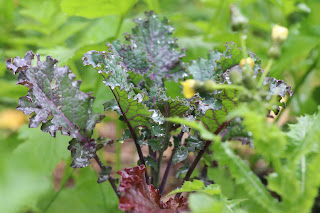
Overwintered kale transplanted from garden box

  • The UBC Teacher Education Office has also made the decision to cancel all Community Field Experiences (CFEs), and we will very much miss working together for these lovely three-week sessions at the Orchard Garden this year!

What is happening:

  • Our Guardian of the Garden, Audrey, brought home all our UBC greenhouse starts and is tending them at her home garden. At whatever time we are able to have one or two of us plant them out at the Orchard Garden (with a very safe social distance between us!), we will do so.
  • We received a small grant from the Jane Goodall A.P.E. fund to start a small permaculture food forest at the Orchard Garden -- and then all grants from this fund were postponed till next year, since most are dependent on school groups meeting. Nonetheless, we may be able to plant a few more berry bushes and fruit and nut trees this spring, to get the first level of our food forest established. Again, it would have to be a small group of us working in socially distanced ways to be safe.
  • As we see what is and isn't possible this year, the members of the Orchard Garden team will let you know adjustments to requirements for the informal certificate of garden-based learning. We keep track of participation in workshops and will honour your involvement!


Home follow-up on Growing Food from Scraps from our March 7 workshop:

There's lots of helpful information linked and shown on Qiaochu's previous blog post on the Orchard Garden blog if you'd like to try this at home!  At my house we are really thrilled to see the green onions growing almost as we watch. A sprouting turmeric root is starting to put out leaves, and half a package of cherry tomato seeds is turning into dozens of sprouts. I highly recommend this activity for some exciting windowsill gardening!


Warm spring wishes

Susan

Thursday, 5 March 2020

March 7th Hands-on Activity: Growing Plants from Food Scraps

Do you know we could grow vegetables from kitchen scraps that you would normally throw away?

Please take a look at this handy guide to grow real food from scraps, it's not only saves money, reduces waste, builds self-sufficiency, creates a sense of achievement, and also brings a lot of fun and spice to your life😉


Here is our plan:

1. A Small Introduction 
2. Game: Guess What Vegetable You Can Magically Regrow
3. Experience Sharing: Regrowing Rosemary and Valentine’s Day flowers by Joy
4. Hearing Your Regrowing Experiences At Home 
5. 17 Sustainable Development Goals (SDGs) to Transform the World

1. A Small Introduction 

'Growing tasty, healthy produce from clean kitchen scraps isn't garbage gardening. It can save money, cut down on food waste, and teach valuable lessons about nature and sustainability. From celery and onions to beets and ginger root, scraps often have plenty of life left. They just need a chance to avoid the compost pile.Growing plants from "inedible" parts isn't that unusual. Gardeners routinely grow crops from pieces of plants. Garlic, for example, is grown from single cloves, and tomatoes and peppers can be started from salvaged seeds. Even new potatoes are grown from their sprouting "eyes."To try your hand at this fun project, start with the following simple-to-grow scraps. You can also experiment with other vegetables by following the instructions for veggies that grow in the same or a similar way. Grow your new food indoors in decorative saucers or containers year-round, or move them outside to your garden in spring.'

And as teachers, we could exploit the possibilities of using garden as a place for teaching and learning...!


2. Game: Guess What Vegetable You Can Magically Regrow


Check the possibilities here:  

An interesting video to share:
 https://www.youtube.com/watch?v=u2z9G6eut8Y  


Some of the vegetables that are suitable for water-planting:


AND HOW...?


3. Experience Sharing: Regrowing Rosemary and Valentine’s Day flowers by Joy


4. Hearing Your Regrowing Experiences At Home 


5. 17 Sustainable Development Goals (SDGs) to Transform the World:


How many goals are related to food and life?