Showing posts with label Class Visit. Show all posts

Friday, 1 August 2014

FUN in the garden

Perennial bee garden, The (new) Orchard Garden
Yesterday, a wonderful thing happened in the garden. After many emails to figure out various scheduling challenges, Food FUN campers and 25 Pre- and In-service teachers in Dr. Sandra Scott's EDCP 328 Environmental Education course came together in the new garden on July 31, 2014.

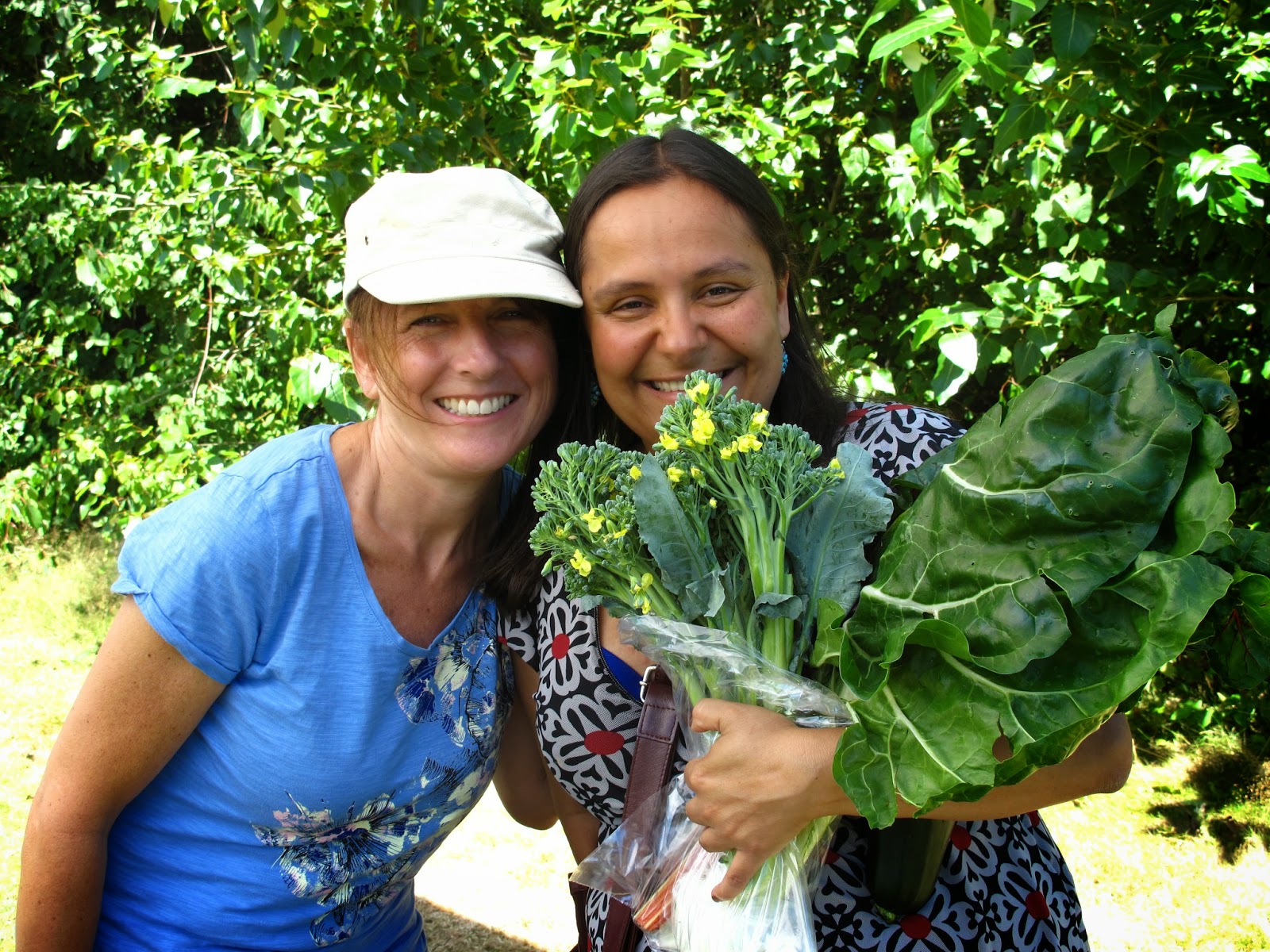
The end of July is a spectacular time in the garden, and the abundance of food of every shape and size was exciting for everyone. For a giant garden salad, we harvested sweet, crisp kohlrabi, carrots, brilliant rainbow chard (enormous!), kale, basil, lettuce, arugula, cucumbers, zucchini, turnip, and, for a splash of colour, nasturtium blossoms.

While some worked to harvest and prepare the salad, others got the opportunity to explore the beautiful perennial herb, flower, bee garden with Navi & Jen's scavenger hunt.

Brilliant rainbow chard
The theme of the FUN camp is food and environment, so after we ate our delicious salad (kids came up for seconds & thirds!) we played a water game, racing as teams to transfer the veggie washing water in leaky buckets to our thirsty apple trees. In a world where 2 billion people are water insecure and agriculture consumes 70% of the world's water, there's lots to talk about when we think about climate change, food security, water issues, and the environment. Students--big and little--had lots of ideas to share for what we can do to make a difference.

"I have plants growing at my house - cucumbers, lettuce, radishes, and just last week I planted carrots!" said one child.

An EDCP 328 student shared how different plants can grow together (polyculture) so that they are healthy and use less water. Indigenous gardeners in North America frequently planted the Three Sisters, the corn, beans, and squash, to grow together providing shade (squash), fertilizer (beans), and structure (corn).

Watering game
Using less water through different irrigation methods was another suggestion, though this led to a discussion as to why most of our food comes from a desert climate in California, where climate change is causing serious droughts and terrible fires.

Thank you to everyone who came to the garden. It was just a short visit, so please come again. It was also likely my last class that I will host in the garden, since I am moving to Ontario in mid-August - so farewell garden, gardeners, and all the wonderful people I have had the pleasure of knowing these past few years!

Julia


Thank you, campers & UBC students!

Wednesday, 30 July 2014

Doctoral students "solidarize" with the garden

Today, a class of doctoral students from EDST's EdD (EDST 593A.971 Ethics in Educational Leadership) program joined me in the garden with their course instructors Jeannie Kerr and Vanessa Andreotti.

Uprooted cherry tree & oak cuttings, old Orchard Garden
We walked down from the Scarfe building, along the 'sacred lawn' on Main Mall, and paused for a moment at the old garden. Jeannie described the old garden as a graveyard, and it really does feel sad and abandoned, particularly now that construction for Vantage College has begun and the giant oak tree that flanked the garden has been cut and piled onto the space. We talked about mourning, in the context of this particular garden but also more generally in terms of the extinctions (of plants, animals, languages...) that accompany globalization and the Anthropocene.

Washing station
The new garden, in contrast, was vivid and vital and filled with surprises and abundance. Harvesting giant chard, kohlrabi, cucumbers, zucchini, kale, carrots, and beets reminded us of the great gifts of life that nurturing the land, being nurtured by the land can offer. What are our individual and collective ways of thanking the land for these gifts?

Harvesting turned to food preparation (and weeding - thank you!) as we prepared a rainbow salad and vegetables to take home. Gathered together around the food, we discussed the course readings around accountability (Ranson, 2003) and decolonization and the pedagogies of solidarity (Gaztambide-Fernandez, 2012).


Thank you to Jeannie, Vanessa, and the wonderful students for visiting the garden and your generous donation. Please come again!


Readings
Gaztambide-Fernández, R. A. (2012). Decolonization and the pedagogy of solidarity. Decolonization: Indigeneity, Education & Society, 1(1), 41-67. 

Ranson, S. (2003). Public accountability in the age of neo-liberal governance. Journal of Education Policy, 18(5), 459-480. 

Wednesday, 23 October 2013

Fog, fall, and failure

My dissertation writing days have begun in earnest now - days spent writing, reading, and sitting inside. Out in the garden, fall and fog transform the space into a mysterious world. It is hard to come to terms with things falling apart but even this has its own beauty.

This morning, two graduate students from an Environmental Education course met me in the foggy garden to plan their class visit next week.

"We don't have anything like this garden at our university in China," the one student commented.

"Well, we won't much longer either," I replied with sad, resigned laughter.

The final stage of my installation based PhD research project, Threads sown, grown & given was to explore the ideas and practices around gift giving, in education and in relation with land. The webs we spun as gifts in March 2013 are slowly collapsing but most still hang, bejewelled with fog dew. My hope now is to carry the energy of the garden and this installation series forward into my dissertation writing. A difficult hope that is sure to fail. But failure, it turns out, is one of the themes of my dissertation I have slowly grown to appreciate: "Just as any human enterprise is defined by what it excludes, it is a culture's failures - quickly forgotten, repressed, buried away - which have the most to say about that culture's beliefs and values" (Antebi et al., eds., 2008, p. 12).


--Julia Ostertag, PhD Candidate, EDCP

[Please search "installation" on this blog for more posts related to my research project. Comments are also always welcome!]


Tuesday, 30 July 2013

Summer Camps at the Orchard Garden

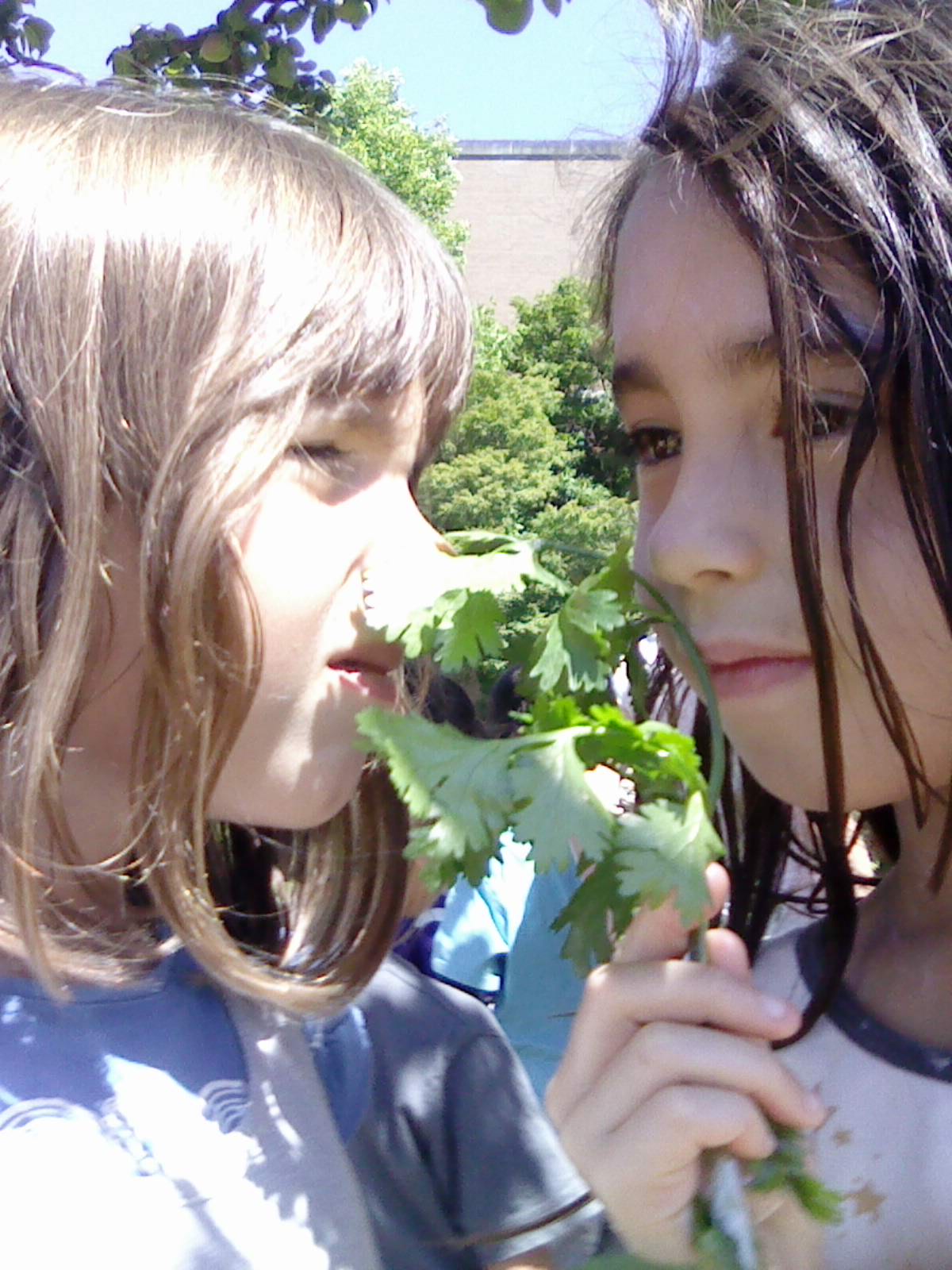
For three weeks this summer, the Orchard Garden is hosting the FUN Society's Summer Camps. they provide fun filled days for kids ages 6-16, and wanted to share their summer with us. Last week, we had our first group out, and played 20 Questions, where kids guessed which vegetable was taped to their back by asking friends for clues. They loved it - especially because they could eat the surprise veggie afterwards!


Next, we had a scavenger hunt throughout the garden, where campers looked for each plant in the garden, and tried their best to name each one. The sprinklers were one that day, so there was an added bonus when searching the greenery :) 


We had a great day, and are looking forward to the next batch of campers next week! Stay tuned.

Sunday, 16 June 2013

Enhanced Practicum Take 2

Last week, the Orchard Garden welcomed our three elementary school teacher practicum students. They will be working with us for the next three weeks in workshops and hands-on garden work as part of learning about teaching in an informal setting. We are running workshops on many things, from local garden histories, to how to start a school garden. And of course, lots of digging in the dirt.

Wednesday, 8 May 2013

The Orchard Garden from the Perspective of two B.Ed students

Beauty. Peacefulness. Tranquility. Colour. Diversity. Abundance. All these words described our first impression of the Orchard Garden. What is this place in the middle of the hustle and bustle of campus life? A place of such freshness, where biodiversity can be seen, heard, felt, and smelled—all five minutes by foot from Scarfe!

Our time in the Orchard Garden has been filled with exploration and learning, in a sense a great mirror of the education process itself. We began our time by investigating the many facets of the garden, using the informative workshop series documents created by the Orchard Garden team. These followed the entire food cycle: from prepping the garden beds, to growth, to harvest, to preparing and eating a meal, and finally returning the end products to the compost bin—so they could become soil anew.

Thursday, 25 April 2013

Student Teachers in the Garden

Student teachers shaping and amending beds
This week, the Orchard Garden is hosting 20 student teachers who are completing their 'enhanced practicum'. This practicum is very different from their classroom practicum, which is 10 weeks long. For the next 3 weeks, these budding teachers will be experimenting with a more informal setting to explore the pedagogy of teaching.
A brief introduction to bees!
At the Orchard Garden, we focusing our work with two students, and are looking at concepts of place-based learning, sharing resources about running and starting schoolyard gardens, and of course, garden work in the dirt as well.

Wednesday, 3 April 2013

Spinning linen memory webs & giving gifts


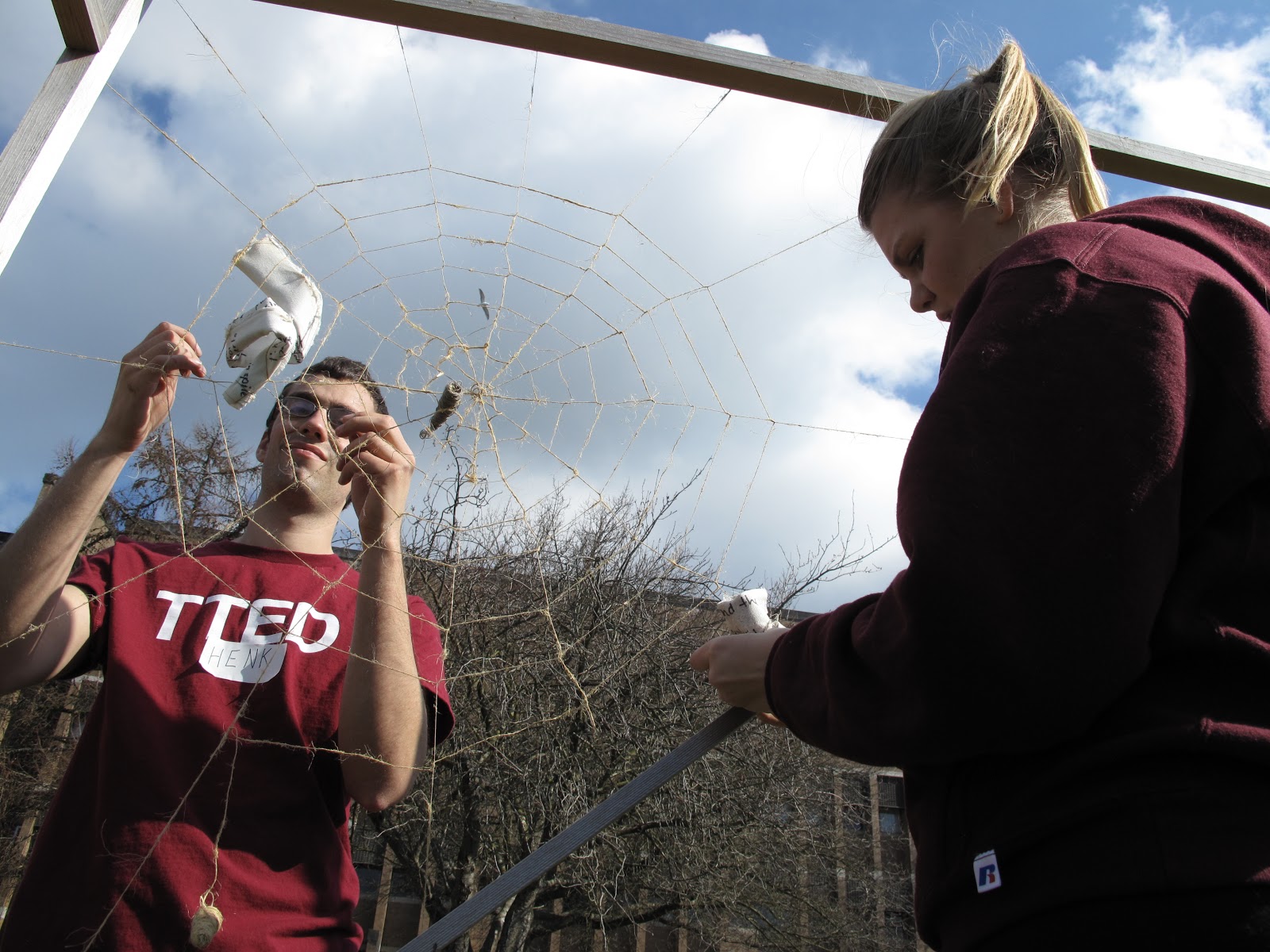
Student teachers becoming memory spiders, March 9
Spring has arrived and the outdoor classroom/school garden installation, Threads Sown, Grown & Given, is slowly changing and re-inventing itself.

On March 9, 2013, student teachers in our workshop series worked together in pairs to spin spider webs throughout the installation site. The linen thread came from the flax that had grown as “desks” in the grid of the outdoor classroom installation the previous summer.

Monday, 25 March 2013

Plan spring/summer/fall classes now

To FoE professors, instructors, TAs, and students, (please distribute widely & apologies for cross-postings)

Are you teaching or a student in a course in the BEd program? Have you noticed how schools throughout the lower mainland and around the world are re-creating their schoolyards as outdoor classrooms? Are you wondering how to integrate gardens into your curriculum & pedagogy?

Well, spring has arrived, and it’s time to come to The Orchard Garden for rich, experiential, embodied, place-based teaching & learning opportunities across the curriculum.
Inline image 3
Student teachers performing teaching in the outdoor classroom installation

Our team is largely comprised of undergraduate and graduate students in the Faculties of Education and Land & Food Systems (LFS) and supported by a strong network of community partners (see http://thinkeatgreen.ca). We work closely with instructors to develop one-class or multiple-class educational experiences with the garden that connect to relevant curricular and pedagogical issues at hand in your course. 

The Orchard Garden is a unique outdoor classroom located behind the MacMillan Building, a short walk from Scarfe and Ponderosa (see map). 
This student-run, inter-faculty garden project grows food for the Agora Cafe, for community sales, and to help connect students, staff, faculty members, and teachers (pre- and in-service) with growing food and garden-based education. Here are some ways to connect with The Orchard Garden on your own or with a class:

  • Request plants to be grown for art projects (e.g., dyes), musical instruments (e.g., gourds), science experiments, math projects, etc. à advance notice required
  • Come for a tour and/or work day to make tangible the pedagogy and curriculum of garden-based learningà 1-2 week notice
  • Plan an assignment or project around the garden à 2 weeks + notice
  • Develop an Inquiry Project, research project, or Enhanced Practicum à advance notice required
  • Have class, meetings, or lunch outside and enjoy the beautiful setting! àNo notice, simply emailtheorchardgarden.educ@gmail.com for our records after your visit
  • Attend special events and workshops in the garden (e.g., Arts in the Garden, April 6, 2013)
Examples of class visit themes include: math, critical thinking, history & social studies, biology, art, philosophy of education, indigenous education, language education, and so much more!

For more information or to plan a visit or project in the garden, please take a look at our website and contact us:


---The Orchard Garden Team

 Inline image 1
Student teachers starting the workshop series, October 2012


Learning to Teach in an Outdoor Classroom is made possible by funding from UBC’s Teaching and Learning Enhancement Fund (TLEF)

Friday, 22 March 2013

Inside the outdoor classroom installation


Flax window at installation, November 2012
On November 20, 2012, a cohort of the teacher education program joined me for a collaborative learning workshop and research day. Since the class has been exploring themes of indigenous education and the relationship between land and education, it was exciting to share my research journey with the students and create a generative space to explore our overlapping questions, concerns, and hopes.

Wednesday, 13 March 2013

Workshop Series #6: Hands On

Our sixth Workshop Series was blessed with a brilliantly sunny day. The kind of day where you can hear the robins, smell the sweet air, and the sun's warmth on your face. We were thrilled to have sun because we spent the whole morning outdoors working in the garden!  We had three stations set up for the student teachers. 

Monday, 14 January 2013

SFU SEEDS PDP Module visit to Musqueam and the UBC Orchard Garden

Last week, I took up a wonderful offer to accompany faculty member Mark Fettes and faculty associate Bill Hood and their SFU SEEDS teacher education group on a visit to Musqueam, and to bring the group on a visit to the UBC Orchard Garden. They later visited the Camosun Bog near Imperial Drive on the edge of campus.


 At Musqueam, Elder Larry Grant took time to tell us about the history of Musqueam and about his own experiences, with his typical generosity, kindness, candour and humour. Everyone in the group was at times both shocked and moved by these stories, and learned a great deal -- there were lots of questions. Elder Grant took us on a tour of the beautiful new Musqueam Cultural and Community Centre buildings, and at my request, we also saw the site of one of the Chinese market gardens at Musqueam, Hong Kong Farms, where Burnaby MLA Richard T. Lee's family farmed for many years.

Elder Grant commented that, although UBC is very closely affiliated with Musqueam, the SFU group was the first group of teacher candidates to request a visit and talk at Musqueam! I was astounded to hear this, and assured him that we would make that situation right as soon as possible. I had not known how to approach the Musqueam First Nation to organize such a visit (through correct protocols, etc.), but a simple phone call to the Band Office is enough to get things started.
The SFU group loved the Orchard Garden and were keen to get involved, especially since the Garden is now under imminent threat of being bulldozed as soon as a year from now if Campus and Community Planning goes ahead with building a 12-storey tower on the site without design consultation. There may be plans in the works for this PDP Module group to come back to the Orchard Garden to perform a drama piece about community gardens on our Arts in the Garden day April 6, 2013 -- watch this space for more details!


Friday, 5 October 2012

EDUC 450B Inquiry One class in the Orchard Garden


We held our Inquiry One Secondary Math and Physics class in the Orchard Garden on the morning of September 20. Twenty-six student teachers and  Ozlem and Lindsey, our grad student teaching assistants, had an introduction and tour of the Garden, then explored the nature of lines and angles in human made and non- human made things in the garden, using charcoal sketches as our medium of inquiry.

Tuesday, 18 September 2012

Shakespearian faeries in the garden

 Costuming was done on the spot --  stylish sprites.
On August 7, Kedrick James' LLED 439 class (Shakespeare in the Classroom) came for a visit to our outdoor classroom in the UBC Orchard Garden. Kedrick and the students in the course were making a film of Shakespeare's A Midsummer Night's Dream in midsummer, using beautiful bucolic locations on campus like the Orchard Garden and the Botanical Gardens. It was a wonderful way for new teachers to experience teaching and learning literature in a school garden.

I hope that we'll be able to link to the finished film here soon!

-Susan Gerofsky

Friday, 3 August 2012

Becoming teachers together

Student teachers performing in the outdoor classroom installation, August 2, 2012:
Conflict between teacher control and student freedom
My response to the installation:
  
~a feeling of juxtaposition between confinement and freedom, the plants were geometrically organized in their set positions but they grew long and free in their places ~a feeling of gratitude for the gift of life...~a feeling of HOPE ~ positivity, tranquility, nature as a healer. (Student teacher, August 2, 2012)
Last week I noted that I would write about flax but right now I'm more excited about the incredible class visit we had at the installation yesterday with a group of BEd students from the Faculty of Education.

The class started at 8:30am, and at 8:00am I was still working frantically with Morgan, a work study student at the garden, to hang the windows at the installation. Finally completed the night before, the windows depict black & white images of school gardens in Europe and North America (I'll post more on this later in response to two students' questions: "Can you describe why you chose the pictures you did for the windows? and "What surprised you about the gardens the Germans created?).

"All this work for what?" I must admit, I frequently ask myself this question. However, the deep respect, attentivity, curiosity, playfulness, and shared teaching/learning moments that filled the garden and our time together yesterday reminded me that teaching matters, gardening matters, and thinking carefully about these practices is as vital as it is complicated.


I think we do need to pay attention to the culture and history of the students because working with the land can be a very personal and culturally significant project. However I always feel the most comfortable when I'm in the garden. I forget that others don't always feel the same. (Student teacher, August 2, 2012)


Moving through the installation, "back of the garden to the front, much like a classroom," students ate the flax bolls, the milky wheat and barley, discovered crisp purslane growing around the desks, picked out lambs' quarters (grey heads, in China, one student explained) and nibbled the leaves. "Sorry, we're eating your installation!" the instructor said. "Perfect!" I replied. "We always use our eyes - it's good to taste things, too."

I also felt a little sad because I realized how foreign gardens seem to me these days. I grew up with one until the age of 10, but haven't been around many since. The garden I grew up with definitely stood out in my memory, so it made me wonder how powerful gardens can be for kids. (Student teacher, August 2, 2012)


  • Why is it so controlled? 
  • Normally I feel calm in gardens, but in this controlled garden I felt uncomfortable.
  • Touching the plants felt nice.
  • The plants want to be free and I don't like that they aren't 
  • Are you doing this to try to teach children about gardening or to prove a point? (Student teacher, August 2, 2012)

In response to that last provocative question: No, I am not trying to teach children about gardening (I'm interested in our practices as teachers!) and I hope that I'm not trying to prove a point. As a research project, I have set out to ask some questions: How do gardens become teachers? What all is tangled up in the very attractive concept of "connecting children to nature" through gardening, especially when we think about the issues of control, colonialism, eugenics, and confinement that characterized some historical school gardening efforts. How can we recognize this problematic, difficult history and re-imagine gardens as reconciliatory and regenerative places? Perhaps another way of replying would be to say that I'm interested less in "points" and more in growing "threads and lines" that connect ideas and people and places. Which brings us back to plants, and flax, and the things and relationships that matter so deeply to us all.

Thank you to Chessa & Morgan for assisting with photography, Jay & Natasha for calling us out of the installation and into the garden to harvest with you for the CSA and for preparing a delicious salad lunch, and especially to all the students for being open and generous, the course instructor for agreeing to participating in this research, and - most importantly - to the garden, the land, the storytellers, gardeners, and teachers who weave us together and make this all possible.

Please feel free to share your comments & reflections here.


Friday, 15 June 2012

Community, Celebration, and Gratitude


Check out our new sign!!  Thanks Chessa!


As has become our tradition, we gathered in a circle this afternoon to acknowledge the land, humans, and more-than-human beings that make The Orchard Garden possible.  Today we came together for our 2nd Annual Summer Celebration as a kick-off to the growing season (CSA starts next Thursday!), to recognize the efforts of our team, our volunteers, and our university administration that continues to support our work as students and learners in this space.


The Dean of Land & Food Systems, Murray Isman, spoke of the power of student determination and grassroots efforts, as well as the unique urban agricultural context of The Orchard Garden on a university campus.


We enjoyed garden-inspired food and drinks made by the student team including:  grilled potatoes and herbs from the garden, blackberry and apricot juice, green salad from the garden, local strawberries, rhubarb crisp, grilled Asian greens from the garden, quinoa salad, lemon poppyseed cake, and lavender shortbread.  The food disappeared in a matter of minutes!


People ate in the grass and enjoyed the rare sunshine.
After our shared lunch, we were joined by a class of teacher candidates in art education and two local artists, Sharon Kallis and Brian Jones, who discussed their work in traditional and contemporary weaving practices.

Sharon describes her work of weaving with invasive plants and engaging community in ephemeral, place-based eco-art throughout the city.

Sharon uses invasive Himalayan blackberry

and Scotch broom...


The group is intrigued by Sharon's innovative and sustainable ideas...

Continuing the conversation of engaging with the land in creative ways, Julia discussed her performative PhD research and the ways she's considering the history of school gardens as well as the assumptions of how classrooms and classroom management are constructed (indoors and outdoors).


Julia points out that maybe weeds represent the chaos and noise that erupts and interrupts an ordered classroom...


Brian Jones, also a local artist, hails from England and is trained in agriculture and traditional forms of weaving.  He discussed the importance of harvest celebrations and the many intricate methods of weaving with almost anything at hand.

Brian's box of weaving treasures

A visitor learns how to braid spelt

Plates were scraped, grasses were woven, weeds were pulled and the rain held off even as clouds loomed ominously.  Susan & Julia graced us with their music and people continue to explore the garden and chat until well past 4pm.  


Thank you to everyone who helped make this day beautiful- especially to Julia, Jay, Natasha, Chessa, Susan, Lauren, Alison, Brian, Sharon & Dean Isman.  What a privilege to be part of this community...