Showing posts with label Research. Show all posts

Monday, 12 May 2014

The Dirt Museum, featuring Orchard Garden arts-based research!

Please considering visiting the Dirt Museum at the Liu Institute's Lobby Gallery. The opening will be May 22 at 12:30, and the museum is a collective of 14 artists'/researchers' work related to the million ways we understand and experience dirt. Julia Ostertag's research at The Orchard Garden will be one of the works featured at the exhibit, which will run until September 2014.

****
The Lobby Gallery at the Liu Institute invites you to the opening of

THE DIRT MUSEUM

reception: Thursday 22 May, 12:30pm ― 2pm

with artists     Omer Aijazi   عمر اعجازئ     Jon Beasley-Murray    Sarah Fessenden    Stephanie Fung   Mascha Gugganig    Bryn Letham    Nicola Levell    Tal Nitsán                Julia Ostertag    Ofira Roll   Melanie Schambach    Sarah Wen    Clayton Whitt    and    Afuwa

exhibition runs until September 2014 at The Lobby Gallery at the Liu Institute for Global Issues, 6476 NW Marine Drive, Vancouver

Wednesday, 23 October 2013

Fog, fall, and failure

My dissertation writing days have begun in earnest now - days spent writing, reading, and sitting inside. Out in the garden, fall and fog transform the space into a mysterious world. It is hard to come to terms with things falling apart but even this has its own beauty.

This morning, two graduate students from an Environmental Education course met me in the foggy garden to plan their class visit next week.

"We don't have anything like this garden at our university in China," the one student commented.

"Well, we won't much longer either," I replied with sad, resigned laughter.

The final stage of my installation based PhD research project, Threads sown, grown & given was to explore the ideas and practices around gift giving, in education and in relation with land. The webs we spun as gifts in March 2013 are slowly collapsing but most still hang, bejewelled with fog dew. My hope now is to carry the energy of the garden and this installation series forward into my dissertation writing. A difficult hope that is sure to fail. But failure, it turns out, is one of the themes of my dissertation I have slowly grown to appreciate: "Just as any human enterprise is defined by what it excludes, it is a culture's failures - quickly forgotten, repressed, buried away - which have the most to say about that culture's beliefs and values" (Antebi et al., eds., 2008, p. 12).


--Julia Ostertag, PhD Candidate, EDCP

[Please search "installation" on this blog for more posts related to my research project. Comments are also always welcome!]


Monday, 8 July 2013

Fireweed dreams

Fireweed and webs
As I sit at home to write my dissertation, the installation Threads sown, grown & given continues to grow and change at the garden. Now it's the season of fireweed. At the centre of the installation, surrounded by linen webs, a circle of fireweed is now glowing amidst the regular garden crops (cucumbers & squashes). Fireweed caught my attention years ago when I first encountered it growing in northern Quebec. To plant it in a garden calls into question what we in fact consider to be "a garden." This weedy plant grows after fires (or clear cuts or other disruptions), spreading rapidly by its thick rhizomes and thousands of fluffy seeds. Beyond being a "weed" and regenerating exposed soil (important work!) it is also a beautiful flowering plant that bees love to visit. From a human perspective, it has been valued as a food plant (the young stems can be eaten), a medicinal plant, and...perfect for this installation project based on threads...a fibre plant (both stems and seed fluff can be spun). Since this final installation engages with the questions of regeneration, reconciliation, and gifts between humans and with the land, this plant spoke to me. However, it was with some trepidation that our garden team invited a weed to live alongside our regular crops.

It appears to be incontournable: This is the last year of The Orchard Garden in our current location. I am filled with sadness but dream that perhaps the fireweed will take root and regenerate the soil and our imaginations after the destruction ends.

Wednesday, 3 April 2013

Spinning linen memory webs & giving gifts


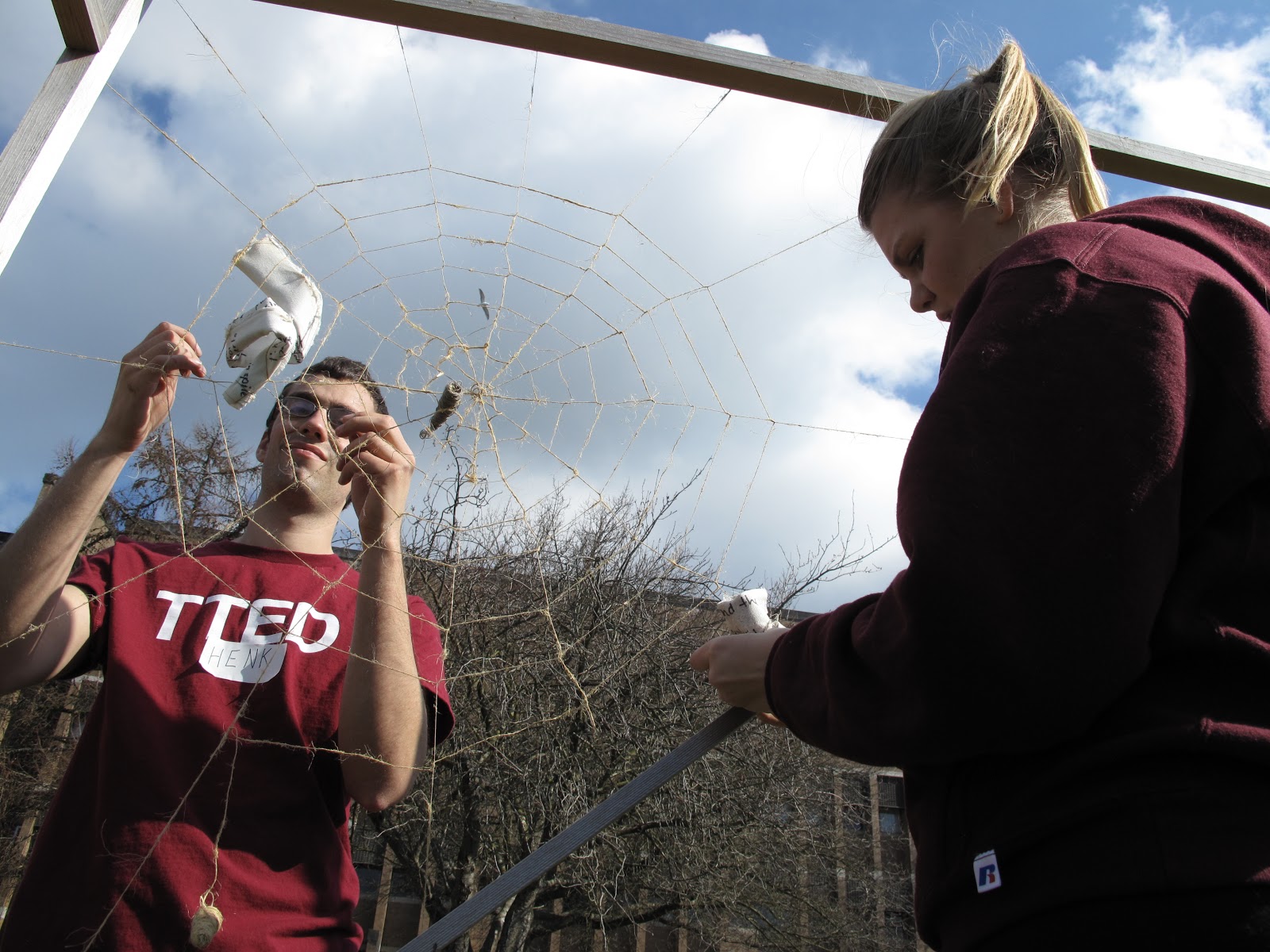
Student teachers becoming memory spiders, March 9
Spring has arrived and the outdoor classroom/school garden installation, Threads Sown, Grown & Given, is slowly changing and re-inventing itself.

On March 9, 2013, student teachers in our workshop series worked together in pairs to spin spider webs throughout the installation site. The linen thread came from the flax that had grown as “desks” in the grid of the outdoor classroom installation the previous summer.

Friday, 22 March 2013

Inside the outdoor classroom installation


Flax window at installation, November 2012
On November 20, 2012, a cohort of the teacher education program joined me for a collaborative learning workshop and research day. Since the class has been exploring themes of indigenous education and the relationship between land and education, it was exciting to share my research journey with the students and create a generative space to explore our overlapping questions, concerns, and hopes.

Tuesday, 20 November 2012

Developing the Chinese Market Garden/Native Plant Garden

The first bok choi at the Chinese Market Garden.  
 About 2 years ago, the Chinese Market Garden and Native Plant Garden was developed. It is a living experiment in teaching and learning about the largely untold shared history of Chinese migrant communities and Musqueam First Nations people here on the banks of the Fraser River, on unceded traditional Musqueam territory.

Wednesday, 31 October 2012

School gardening research events, Scarfe buliding Nov 13-30


From November 13 - 30, join Julia Ostertag in the Student Lounge of the Scarfe Building (Room #10, basement) to see and explore the themes of her PhD research project, Threads Sown, Grown & Given. On November 13 from 3-5pm, there will be a public opening of the indoor installation. Throughout November 13-30, you are invited to join Julia for daily threading conversations from 10-12, also in the student lounge. During these daily events, Julia will work with materials from the research, screen images from the summer garden installation, and invite the public (student teachers, undergraduate and graduate students, faculty members, instructors, staff and the general public) to join the research process.

If you are interested in participating in the research, please contact Julia for a consent form (julia_ostertag@yahoo.ca) and bring it to the student lounge on the day you plan to attend an event.

Vielen Dank, Lena Schrieb, for the incredible poster! (http://www.lena-schrieb.de)

Monday, 22 October 2012

Flax to Linen

Linen fibre skeins: 6 hours of work, 124 grams of unspun linen
On Friday, I took two giant bags of flax plants (pulled, retted, and then dried in my living room...imagine the mess!) on the ferry to Victoria. There I met Barb and folks from the Flax to Linen project, who  - with incredible generosity - shared their tools and experience with me as we worked together to transform flax plants to linen fibres.

The steps of the process are:

Friday, 28 September 2012

Listen to Michael Pollan on Ted Talks - a great exploration into other sentient ways of being alive with the more-than-human, particularly plants. I love imagining the ways of knowing of plants and the things we can learn from this perspectival shift, as Pollan suggests. This is the technology we need to change the world!

For more on this, you can also watch Smarty Plants on the Nature of Things with David Suzuki. Really  fascinating implications for how we conceive of "consciousness" as not within entities but within relationships.

Julia

Tuesday, 25 September 2012

Flax formations

One blue flower opens every morning: 30 days after flush of flowers, flax is ready to be pulled and dried (for linen)


In an earlier post, I said that I would I write later about flax. Perhaps this story is conveyed most succinctly and beautifully in a 15 minute video by Benoit Millot available on Vimeo.

Monday, 24 September 2012

Enclosures and trespassers

cut seed bolls, retting flax, September 2012
The etymology of the word 'garden' can be traced back to the word 'enclosure'. As such, it is a territory - one that, whether in imagination or in reality, may be trespassed.

On Wednesday last week, for the fourth time, I went to work with the flax at the garden only to discover that an invisible hand had cut off seed bolls and removed large portions flax from where it's been drying and retting in the field (dew retting is the slow rotting process by which the linen fibres separate from the woody "boon" or outer stem through moisture, heat, and the collaboration of a multitude of micro-organisms, click here for more on retting).

Thursday, 16 August 2012

Installation harvest visits

As a site-specific installation/research project, Threads Sown & Grown, Woven & Given, is an ephemeral and transient experience. This first phase of the installation, Threads Sown & Grown, has constantly changed - from a grid of strings marking the spacing of desks and walkways, to feathery green beds of small flax plants, to a sea of waving blue flowers. However, I have often wondered when everything would come together and feel "complete." Just a few days ago, I reconciled myself that things (windows, walls, bean plants, wheat, cover crops, and flax plants) would never synchronize their "becomings" and be what I had somehow envisioned. And then, it happened.

A volunteer and I pulled the last "desks" of flax, ready to be harvested for linen. At the last moment, I decided to try stooking the sheaves of golden flax, long strands with tousled seed boll heads, and placing the stooks on the desks of their origin. Suddenly, small human forms filled the classroom, with a taller figure at the teacher's desk. The few remaining desks of flax, left to ripen for flax seed instead of linen fibre, occupy the remaining spaces, and faint green cover crops delineate the original grid of the classroom geometry.


Just as things have come together, I have left for a holiday with my family in Ontario. I'm sad to be missing this beautiful time in the garden; however, I invite you to enjoy it before Monday or Tuesday next week, when the stooks will be gathered by The Orchard Garden team and the installation changes again. Bring your camera and send me a picture!

Friday, 3 August 2012

Becoming teachers together

Student teachers performing in the outdoor classroom installation, August 2, 2012:
Conflict between teacher control and student freedom
My response to the installation:
  
~a feeling of juxtaposition between confinement and freedom, the plants were geometrically organized in their set positions but they grew long and free in their places ~a feeling of gratitude for the gift of life...~a feeling of HOPE ~ positivity, tranquility, nature as a healer. (Student teacher, August 2, 2012)
Last week I noted that I would write about flax but right now I'm more excited about the incredible class visit we had at the installation yesterday with a group of BEd students from the Faculty of Education.

The class started at 8:30am, and at 8:00am I was still working frantically with Morgan, a work study student at the garden, to hang the windows at the installation. Finally completed the night before, the windows depict black & white images of school gardens in Europe and North America (I'll post more on this later in response to two students' questions: "Can you describe why you chose the pictures you did for the windows? and "What surprised you about the gardens the Germans created?).

"All this work for what?" I must admit, I frequently ask myself this question. However, the deep respect, attentivity, curiosity, playfulness, and shared teaching/learning moments that filled the garden and our time together yesterday reminded me that teaching matters, gardening matters, and thinking carefully about these practices is as vital as it is complicated.


I think we do need to pay attention to the culture and history of the students because working with the land can be a very personal and culturally significant project. However I always feel the most comfortable when I'm in the garden. I forget that others don't always feel the same. (Student teacher, August 2, 2012)


Moving through the installation, "back of the garden to the front, much like a classroom," students ate the flax bolls, the milky wheat and barley, discovered crisp purslane growing around the desks, picked out lambs' quarters (grey heads, in China, one student explained) and nibbled the leaves. "Sorry, we're eating your installation!" the instructor said. "Perfect!" I replied. "We always use our eyes - it's good to taste things, too."

I also felt a little sad because I realized how foreign gardens seem to me these days. I grew up with one until the age of 10, but haven't been around many since. The garden I grew up with definitely stood out in my memory, so it made me wonder how powerful gardens can be for kids. (Student teacher, August 2, 2012)


  • Why is it so controlled? 
  • Normally I feel calm in gardens, but in this controlled garden I felt uncomfortable.
  • Touching the plants felt nice.
  • The plants want to be free and I don't like that they aren't 
  • Are you doing this to try to teach children about gardening or to prove a point? (Student teacher, August 2, 2012)

In response to that last provocative question: No, I am not trying to teach children about gardening (I'm interested in our practices as teachers!) and I hope that I'm not trying to prove a point. As a research project, I have set out to ask some questions: How do gardens become teachers? What all is tangled up in the very attractive concept of "connecting children to nature" through gardening, especially when we think about the issues of control, colonialism, eugenics, and confinement that characterized some historical school gardening efforts. How can we recognize this problematic, difficult history and re-imagine gardens as reconciliatory and regenerative places? Perhaps another way of replying would be to say that I'm interested less in "points" and more in growing "threads and lines" that connect ideas and people and places. Which brings us back to plants, and flax, and the things and relationships that matter so deeply to us all.

Thank you to Chessa & Morgan for assisting with photography, Jay & Natasha for calling us out of the installation and into the garden to harvest with you for the CSA and for preparing a delicious salad lunch, and especially to all the students for being open and generous, the course instructor for agreeing to participating in this research, and - most importantly - to the garden, the land, the storytellers, gardeners, and teachers who weave us together and make this all possible.

Please feel free to share your comments & reflections here.


Wednesday, 25 July 2012

Welcome to the outdoor classroom installation

This is my first blog post for “Threads Sown & Grown, Woven & Given,” the title of the outdoor classroom installation series that is central to my PhD research into the relationships between gardens and education.

Outdoor classroom installation (bottom right) at The Orchard Garden, UBC. July 18, 2012

First of all, for readers of this blog who live in the Vancouver area, I invite you to visit The Orchard Garden on the UBC campus to experience this site-specific installation as you might any artistic installation: by moving through it in situ with an open, attentive mind and mindful body. Come by any time or contact me in advance if you would like me to join you in the garden. [If you’re interested in learning more about earth art as a form of site-specific installation art, this is the time to visit Vancouver’s Van Dusen garden].

Secondly, since this blog is an important space for documenting an ephemeral arts-based research project, I invite you participate in the process by sharing your own comments, thoughts, links, questions, and so on. I will moderate comments to ensure that there is no identifying information and that all postings are respectful. Contributions to the blog will form part of my “data” for my doctoral research, and may be included in my dissertation, publications, and presentations.

Finally, what is this project about? In future blog posts I will write more about the historical, material, and theoretical “threads” of this research and installations. In very general terms, however, through an arts-based research process, I inquire – with loving criticality – into the relationships between gardening and education, and specifically the concept of “garden (or nature) as teacher.” Together with teacher education students at UBC’s Faculty of Education, I explore how a garden is an enclosure, much like a classroom perhaps. It frames what is known and knowable. But what else is possible?

Desks growing in neat rows. July 9, 2012
The first phase of this installation series, “Threads Sown & Grown,” creates this frame: it is where I planted a classroom with 24 student desks and one teacher’s desk, all out of flax. The walls are framed with cedar posts, wheat & barley, and tall bean plants. Windows – still in progress – will depict a montage of historical school gardening images, including more problematic contexts such as Nazi Germany and residential schooling.

The second phase, “Threads Woven & Given,” explores what else is possible. Beginning,in September, I will harvest the flax and, alongside teacher education students, create a linen textile installation that will be returned to the garden in the spring as a regenerative gift. Central to figuring out how to turn flax into linen will be collaborating with the incredible Urban Weaver project.

I will try to conclude each post with a question or two. Here’s a big one: Does teaching with gardens make other ways of knowing and being possible? How? Why might this be difficult?

Or, if you’re interested in something more concrete: How does flax become linen? Do you have any experience with retting, breaking or scrutching you’d like to share? Or resources/tools?

On that note: My next blog post will delve into my love affair with flax…

Thanks for reading,
Julia Ostertag
PhD Candidate, Department of Curriculum and Pedagogy, UBC

(Please email julia_ostertag@yahoo.ca if you would like more information about the project)