Thursday, 8 June 2017

CFE day 4 blog post

Today started off with two wonderful presentations by Kwesi Yaro and Philip Kimani. The first presentation started with introducing to us what gardening looked like within Ghana's educational system. We were informed that after a drought in the 1970’s, the government introduced a new plan called Operation Feed Yourself. This new law mandated that high schools and elementary schools have gardens for teaching and for cultivating as a way of making educational institutions agriculturally sustainable. For the project, most schools were given about 4 acres of garden. Of these four acres, most was designated for growing crops, however a small section of the garden was left untouched and dedicated to teaching and experiments where the students could learn. For example, one grade 7 project was to grow a vegetable in the garden from seed to harvest -- they were graded afterwards on the outcome of their crops.
While learning about the gardens in Ghana we also gained some valuable skills Formteaching out own students in gardens. For example, in his presentation we learned that it is best to show a demonstration to only 2 students at a time while others are working and to get others to come see the demonstration afterwards, instead of just one large group. The main thing about garden teaching is the space we have and we have to make sure we are always using it.
For the second part of the presentation we started learning about gardens in Kenya. This was the presentation we found the most inspiring. We learned that the presenter had started his own school in the desert like city ofVoi, Kenya. The school started with 20 students and has since grown to over 200 students. He talked to us about how the first issue for the school was that they did not have an water source. Transporting water in my the truckload quickly proved to be expensive and unsustainable. However, he explained that once they started getting donations from Canada they were able to afford to create their own water source. The next project was a garden, in fact, this idea had come from the imagination of the students themselves. The students began growing and harvesting kale and progressed to other crops such a step oranges. Throughout this journey the students and teachers learned many things. For example, that watering mid-day was ineffective and the water would just evaporate. They also found that rabbits poo was great as manure for the garden and that their pee was an excellent pesticide. They also planted Moringa, which had medicinal properties and they saw an increase in health among the children once they started feeding it to the students.

After these wonderful presentations we had some time to read some resources on how to use a garden in our teaching. There were some wonderful resources identified while reading. For example, The Garden Classroom by Cathy James. We discussed these resources among the group and next thing we knew it was lunch! Sadly, today there was no time in the garden due to the rain!
- Laurence and Meg

CFE - Day 3 - Tyee Elementary Garden Tour

Another lovely day at the CFE! 

Today we had the opportunity to explore the school garden at Tyee Elementary School. Tyee is a Montessori school and, with ease, incorporates their school garden in all aspects of daily classroom life.

Tyee Elementary School

Our morning started out with a brief introduction to the Montessori philosophy and what a typical Montessori classroom looks like. We were able to observe and explore a Grade 1/2/3 classroom which allowed us to see how a Montessori lesson may be taught, the various manipulatives they have available to them, how they incorporate the garden into their classroom, etc.

Next, we had a tour through the garden which was led entirely by several intermediate students. They were incredibly knowledgeable and were able to answer all of our questions! They walked us through the garden, pointing out various plants and projects. Their garden consisted of eight raised beds filled with vegetables, a pollinator patch, raspberry bushes, apple trees, a variety of herbs, and bins filled with potatoes from the Spuds in Tubs program. Additionally, they had "bug motels" and mason bees to help pollinate their garden.

Tyee's School Garden

In particular, the students taught us about how plantain is a natural antiseptic that you can chew and put on insect bites or cuts and that dandelion has a variety of uses such as putting it in salads, using it for tea, and using the stems to make vinegar.

We finished off our morning with a wonderful slideshow put together by one of the staff members. She provided us with a plethora of ideas for garden-based, child-centered lesson plans. In particular, we were rather impressed by the idea of a Pocket Market that involved the entire school using only materials from the garden. Each class would harvest something from the garden and together they would create a shop and sell/trade their item at the market. For example, some students made organic cleaning supplies made from items from the garden. Another class harvested the herbs and sold them. Other examples include: homemade cards, salad dressings, bouquets, and soups.

Spuds in Tubs Program

Tyee Elementary was a welcoming and warm environment. We learned so much about the Montessori program and how to implement a garden at any school - whether they have one started or you're beginning from scratch. It was wonderful to see the school garden in action and to witness the students take such pride and responsibility for it. The benefits of having a school garden were evident and inspiring.


UBC Teacher Education Program Community Field Experience 
Lexi.P & Sara.L

Tuesday, 6 June 2017

CFE - Day 2


On our second day of CFE, we began our morning with an informative presentation by Julian.  He provided much insight about the inner workings of food systems, such as production, distribution, acquisition and the consumption of food both a local and global scale. 

Throughout Julian's presentation, we had several intriguing discussions and activities about the foods we consume and the complexity behind the microcosm food system. During one of our discussions, our task was to brainstorm the flow of inputs and outputs within a home and its relationship to food acquisition.  For example, when farmers produced crops, they need to consider factors such as land surplus and energy used as a result from machinery to harvest their crops before sending their crops to distributors.  Essentially, there is more behind how food gets onto the shelves of grocery stores.

Furthermore, some of the core terms that heavily influence the theory behind food system include political ecology (considering the structural imbalance of power), food security (having sufficient quantity/quality/culturally appropriate food), food literacy (having knowledge of how food is produced) and, food sovereignty (people having the right to eat culturally appropriate foods).


In Julian's presentation, we also discussed as a class what actions could be taken to make a difference (an ideal food system).  Some of the points that we felt strongly about included reducing meat and animal produce, being an environmentally friendly/socially consciously consumer in regards to our food choices, and to eat locally in order to reduce our carbon footprints.


In the afternoon, we went to the Orchard Garden to make a hospitable environment for our soil/plant beds by pulling out weeds that would take away nutrients from our crops.  Also, there were many steps we had to take in order to prepare the soil/plant beds to transplant our vegetables.  We first prepared the soil by making markings in the soil to indicate how much space there would be between each plant, added organic mushroom fertilizer, mixed up the top soil and the fertilizer together before transplanting our zucchinis and watered them.


Overall, it was a both an informative and productive day!


Monday, 5 June 2017

CFE - Day 1

What a lovely day to start our Community Field Experience at UBC’s Orchard Garden!

We began our morning with introductions, sharing, exploration, and safety. First, we acknowledged that we were on the on the traditional and unceded territories of the Musqueam people and reflected on this as we prepared to work with and on the land. Then, as we sat in the garden, the sun shining and the birds calling, we had a chance to meet each other and get started. To begin, we talked safety. In small groups, we acted out the safety protocols in an effort to make the information fresh and entertaining for each other.


We also paused to think about why we want children to learn in the garden. Our discussions touched upon our need to provide a way for children to connect to the land, get dirty, and see how food it grown. We talked about responsibility, patience, and work ethic that comes from gardening. We also reflected on how children need to balance a busy and technology driven world, and that gardening and being outdoors is a way to find balance, by improving mental health and physical well-being.


From there, we were set free to explore the orchard garden by going on a scavenger hunt! What fun! We searched for windy places, birds, sweet scents, plants we recognized, and places to linger. It was a peaceful and relaxing stroll, as we examined every plant we came upon, tried to name the birds we saw, and held leaves to our noses to inhale the sweet scents. When we returned we shared what we found, what sparked our interest, and what questions we had. We ended up by the rose bushes, as the morning came to a close, smelling the sweet white flowers and reflecting on what brought each of us here to the orchard garden. I look forward to learning more about each other and about gardening in the days to come….


In the afternoon, we got to work preparing the orchard garden for planting. Under Julian's watchful eye, half of our group weeded out the garden beds while the other half cleared away the grass and flattened them.

Before

After

As we worked, some of us reflected on our practicum experience and how our students would benefit from being outside and interacting with natural surroundings. They can learn much through hands-on activities like gardening or build up their sense of curiosity simply by observing plant and insect life. We have discussed how nature can have a calming effect, and yet provide a rich environment for outdoor education and daily physical activity.


As we discussed earlier in the morning, we believe that children should know where their food comes from and learn about healthy eating. Digging out the grass, digging out the weeds, turning and flattening the soil, and carrying the plants to the compost helps us to see how much effort is needed to produce our food. Having students work outdoors can help them appreciate what goes into their lunch boxes and hopefully make them more mindful about healthy eating and not wasting food.


It was also refreshing to work with and hear experiences from different cohorts since we did not have many opportunities to do so before. Although our cohorts emphasized different aspects of pedagogy, we all came to the conclusion that gardening is a valuable, soothing, yet stimulating teaching tool which promotes outdoor education, physical activity, and food security.

Elementary and Middle Years CFE Starts Today!

We are so excited for the second CFE of the season, Elementary and Middle Years, which starts today!  The teacher candidates met in the garden this morning, and we're off to a great start!  See the schedule below (correct as of June 4 but still subject to change!) -- click on the image to enlarge it so that you can actually read it!

Sunday, 14 May 2017

CFE workshop

Three weeks have flown by and sadly our CFE is complete. Our final workshop went smoother than any of us had hoped for, and we had the chance to celebrate our success and experiences with some of our peers. Everyone who arrived had some connection to education, and all were happy to leave with their own new plant to care for. It was a bittersweet conclusion; we're happy to have succeeded and had such a great learning experience in the garden, yet sad to leave our outdoor offices behind.


We wrote short stories, drew soundscapes, created crops and budgeted stocks; we covered the curriculum from Art to Mathematics. We leave as we came, inexperienced yet inspired, educated yet hungry for knowledge, and tired yet excited for the future that lies before us. Some of us know where we'll be teaching ext year, and others haven't the faintest idea, but we leave having experienced first-hand the value and joy of the incorporation of outdoor education. We already came with the desire to incorporate it into our pedagogy and thanks to the orchard garden, now we have the vision too.

It has been a lovely three weeks and a wonderful community field experience, and I hope that everyone involved has a future career ahead of them as bright and beautiful as the past three weeks have been. Some days it may rain, but so long as the light within each of us shines through it's enough to keep the spirits up.

Happy trails ahead!

Brendan

"It was the best of times, it was the worst of times, it was teh age of wisdom, it was the age of foolishness, it was the epoch of belief, it was the epoch of incredulity, it was the season of Ligh, it was the season of Darkness, it was the spring of hope, it was te winter of despair, we had everything before us, we had nothing before us, we were all going direct to Heaven, we were all going direct the other way - in short, the period was so far like the present period, that some of its noisiest authorities insisted on its being received, for good or for evil, in the superlative degree of comparison only"

Our CFE has come to an end.

The workshop on Saturday was a good end cap for the three weeks that we have spent together. We were able to come together one last time, in both the garden and the classroom settings, and express ourselves. Through the creating and presenting of the workshop we were able to delve into different subject areas, granted it was not a spurlunking but a mere surface skimming. We were also able to come together as friends one last time. It was exciting to be able to witness the creativity of nine different minds melding together to form 1 four hour workshop.

To draw another comparison, it was like Christmas with the family. The food, the surroundings and the people all serve as both comfort and entertainment.

It was also exciting to see that there were other people willing to venture into our presentation, they appeared to have fun and enjoy themselves, I know that my sister came away with some fond memories.

Thank you all again for the laughs and the learning!!

Sasha

Thursday, 11 May 2017

May 11 - Aboriginal Math Symposium

A Rainy Day at the Aboriginal Math Symposium - Danielle and Joyce

Today instead of meeting at the Orchard Garden, we met at the Sty-Wet-Tan Hall First Nations Longhouse at UBC for the Aboriginal Math Symposium. Half of us took the morning shift and were responsible for setting up and preparing for the symposium and the other half was responsible for the clean-up. We were both part of the morning shift and came early in the morning to help set-up. We put together all the tables, chairs, and food stations for 150 people. 

The symposium began with a song welcoming all the attendees to the symposium. The symposium focuses on connecting and exploring  new ideas, resources and research on Aboriginal/Indigenous mathematics educations K-12. We listened to drumming, singing, and stories. The audience also honoured our animal brothers and sisters by acting out wolves, eagles, and killer whales. 
One of the first activities of the symposium was matching years to important dates and events from Canadian aboriginal history in small groups. We got to participate in this as well and were given a packet that contained rope, paper clips, different years written on pieces of paper and different events on other pieces of paper. The task was for groups to match up the year cards with corresponding event cards.  We were to make a timeline and sequence the events in order. Events ranged from British settlers landing on the west coast, to the installation of Residential schools, to First Nations federal voting rights. 
- discussions made on connections between activity and math
- this activity brings math into cultural context

After the timeline activity, each table was asked to look at and find differences and similarities between 5 maps of the lower mainland that were on each table. Tables had different maps, but all ranged from the years 1850-1980. Tables were encouraged to mingle with other tables to compare maps. Us volunteers had a few maps to look at too and it was interesting to see all of the changes that took place in Vancouver not so long ago.


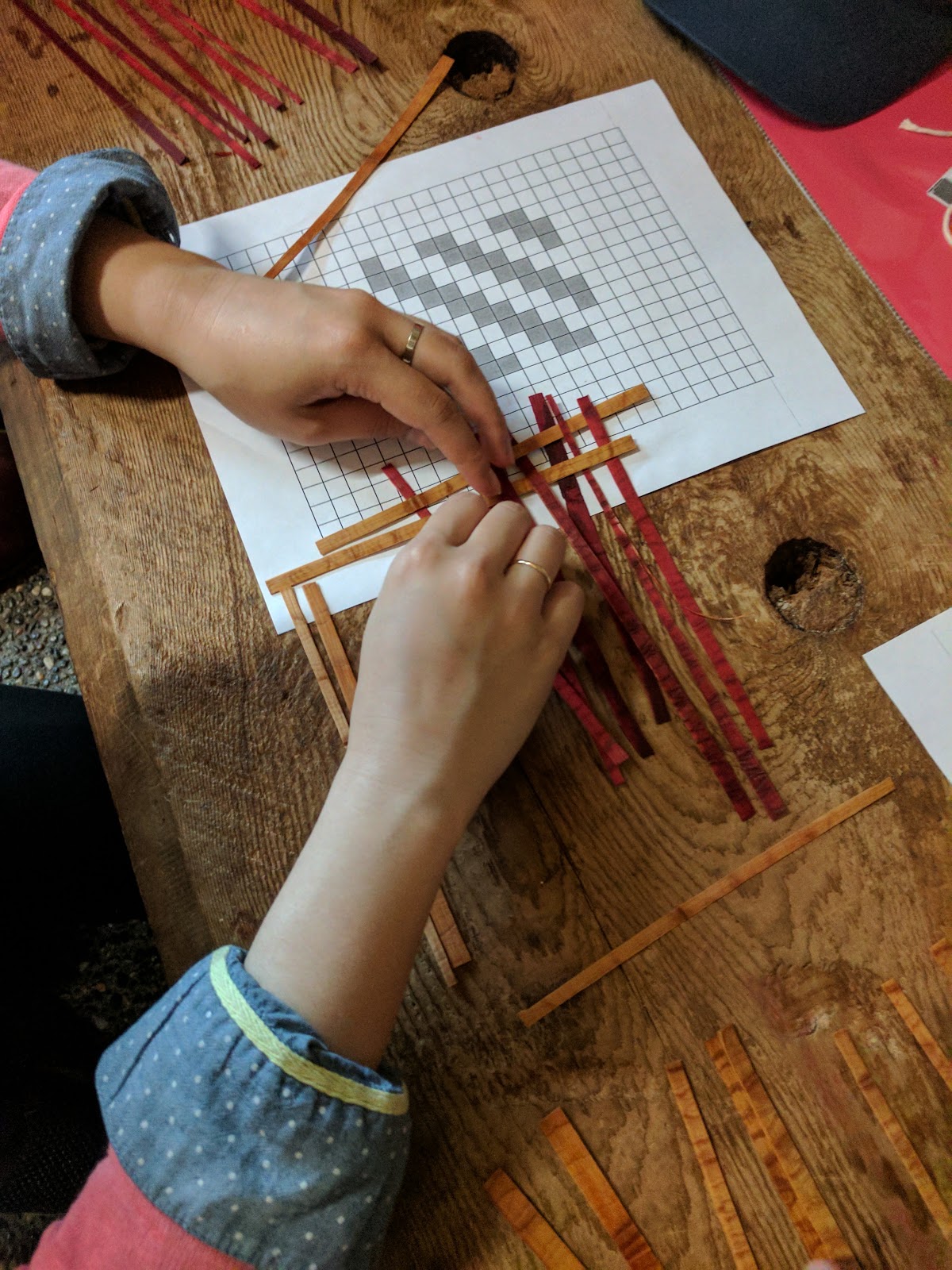
The following activity focused on deepening mathematical pattern awareness through Cedar weaving. Each attendee were given two pieces of paper consisting of 3 different patterns. Attendees were asked to create and continue the pattern on sheets. After giving attendees some time to complete the pattern, the connections between patterns and math were distinguished. After the discussion, attendees were give cedar barks to create and weave based on a pattern on the sheet of paper. I found this activity particularly interesting and engaging. The activity allows participants to not only exercise their ability to recognize patterns but also to provide hands-on experience.
                                                         

After the Cedar weaving, multiple educators shared their experience and how their activities shared connections with Aboriginal math. One of the stories I remember in particular is by David Sufrin. He discussed how mathematical scales can be taught through the creation of teepees. Groups were expected to work together as well as observe and make their own teepee. Students were expected to make a well-proportioned model teepee.