Wednesday, 26 April 2017

Orchard Garden CFE April 26


Jenny - School gardens in other countries and cultures


For our morning session, we had a guest speaker, Kwesi, who shared about the school gardens in other countries and cultures - in particular, Ghana.

We started off by learning about the history of school gardens in Ghana. It was interesting to see how gardening and farming are very well embedded into people’s daily lives. Even in terms of education, elementary and high school are mandated to have school gardens in Ghana. We looked at an example of a grade 7 science project where students have to grow a named vegetable crop from seed to harvesting. It showed that the Ghanaian education system aims to really encourage garden-based learning by providing a curriculum that revolves around students physically working in the school gardens.

Then we had a discussion about how gardening is different across cultures. Specifically, there was an interesting conversation about how in some cultures, people tend to have dominance over nature by controlling where to grow things, what to grow, how it must be designed, etc. On the other hand, in other cultures, people appreciate the randomness of nature and just let the nature decide on its own.


As well, we also conversed about how different ingredients brings significance to different people. When Kwesi showed us some photos of the trees and crops in Ghana, it was hard for us to recognize and identify what they were because we weren’t familiar with those ingredients. However, they will have a great significance to the Ghanaian people because they depend on those things in their daily lives. It is similar to how Korean people will depend heavily on rice and Korean cabbage (for kimchi) because they are a part of our daily diet whereas it might not be that significant to people from other cultures.

Overall, it was a great session where we got to see a real example of how Ghanaian education system has adopted garden-based learning to its core level and see the great outcomes it has on the students.


Benefits/Outcomes of Garden-Based Learning (as mentioned by Kwei):

  • Some students replicated the school garden in their homes and in the future, they will be able to earn a living (life-long learning)
  • The produce were distributed to the children at the end of each harvest
  • Children learned to appreciate the value of vegetables in a balanced diet
  • Symbol of collaboration between the school and the community


Colin - Tour of Windermere school gardens, greenhouse, composting and orchard
Courtyard Garden
The Green House

In the afternoon session, we went to Windermere Secondary School to have a tour of their school gardens, led by three of the students responsible for running the spaces, allowing us to see school gardens in a local context.

The tour started in a school courtyard where there is a green house, plant beds, along with bushes and trees.  Our guides started by showing us their green house where they get seedlings started on their journey.  It was immediately clear the amount of work that our guides and their fellow students have put into the garden projects, and also the pride that they take in the work they have done.  The projects are student led, through the leadership classes, making the students responsible for planning and implementation of projects and ideas.

Raspberry bushes
After we toured the green house, we continued on to the rest of the courtyard garden, seeing the many plant beds, and raspberry bushes that provide healthy, local food, to the school cafeteria during the growing season.  Because the harvest for some of the plants grown does not coincide with the school schedule, the leadership class has previously organized for the bounty of fresh produce to help the local community, arranging for local charities to make use of the produce.

Solitary Bee Homes

Community and school engagement was a constant theme throughout the tour.  With our guides talking about the garden spaces not only providing food, but also providing a space where learning can happen outside of the classroom.  Where plays for english or drama can be performed, where physical education involves creating and working in the gardens, where you can learn about the needs of solitary bees, and create an art.

The Orchard Garden

After visiting the courtyard garden, we toured the orchard garden, where there were a variety of fruit trees and bushes, and well as even more plant beds.  Occupying a corner of the sports field, in-between a road and a baseball diamond, the space is being utilized in a very nice way.  Providing more food, opportunities for different approaches to gardening, and once again community engagement with signage that informs and engages.
Signs in the orchard
Overall, it was a very successful, inspiring tour.  The passion and dedication that our tour guides had for their projects was evident, and is something that all of us will try to replicate throughout out teaching careers

Photos from Children & Nature conference interactive workshop at the Orchard Garden April 19


Orchard Garden CFE April 25

Dilpreet — Food Sovereignty:

The Orchard Garden CFE has been an enjoyable experience the first few days. During the practicum we were all going 100 mph so it has been nice to take a little step back. After our introduction yesterday, I had high hopes for CFE today. Everyone has been so nice and pleasant to work with. The atmosphere is awesome and I like that everyone does their part to contribute. Today we covered food sovereignty for the first part of the day and then ended off by going for a walk to wreck beach with a big group.

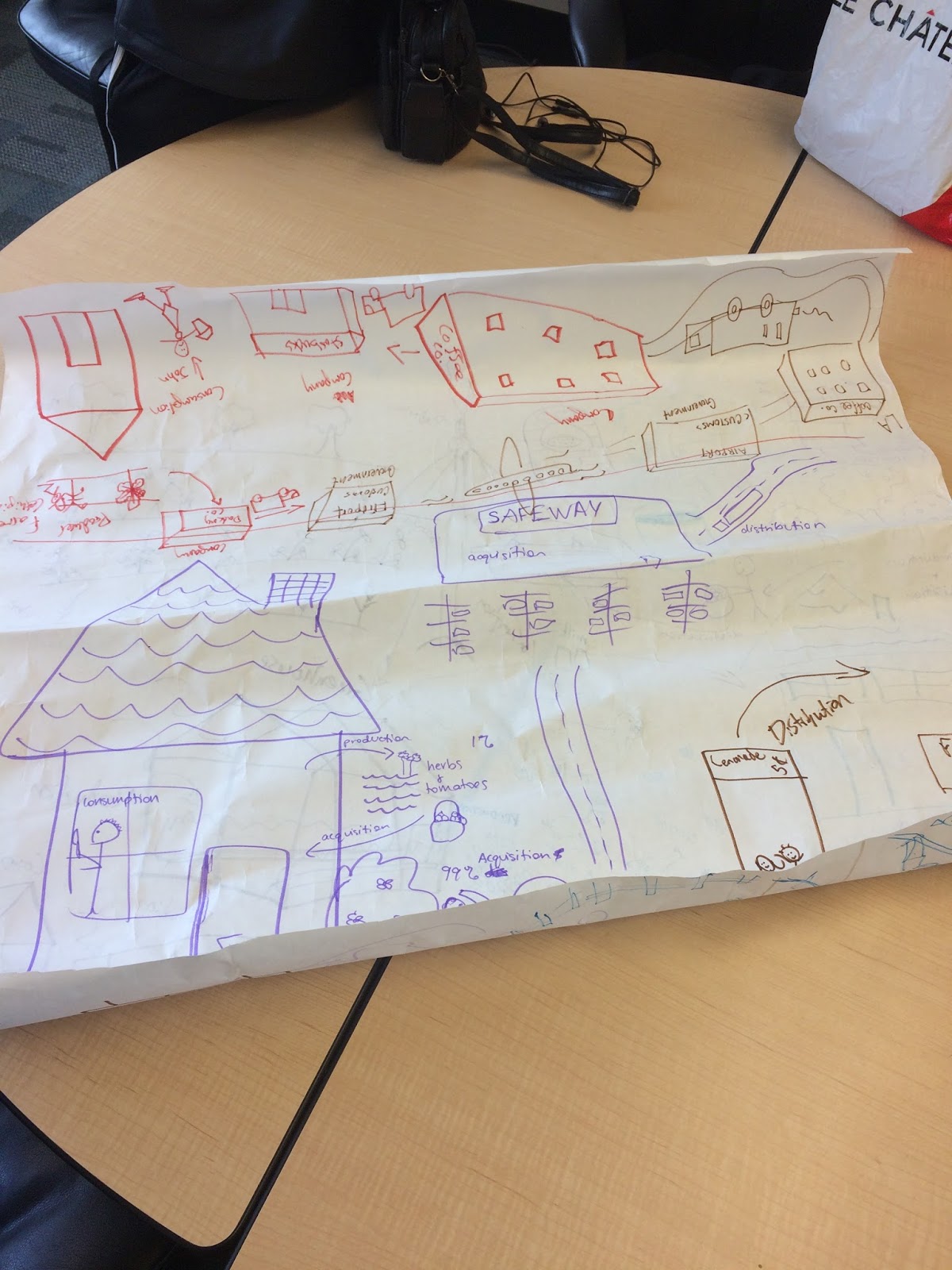
Our first activity for food sovereignty had us working in teams to draw a diagram of 4 components. These 4 components were acquisition, production, distribution and consumption. We had to base our diagram on how these 4 components are used to bring food in and out of the house.  Acquisition happens when we purchase food from stores, when stores purchase from supplier or other people purchase from us. Production occurs when food is produced on farms, in our gardens, greenhouses, etc. Distribution happens when the food is moved to and from stores, to and from our house, to and from farms, etc. Consumption is usually the last step as the food will end up in someones belly.


 For our next activity, we worked on making a diagram of what would be the ideal living situation for a subsistence farmer(live off own land). Most groups had close to the same ideas of the ideal situation. The farm would have animals, lakes and rivers, fields, forest, greenhouse,energy source, etc.
The last activity we worked on focused on products from different countries and how they get to Canada. Again, we made diagrams in the same groups and although we had different products, the process for all were very similar.

We ended off with a discussion after learning about how the world has changed in good and bad ways with food consumption. There are many good things coming from the abundance of food we have now as compared to the past. Things are so easy to get and there is an increasing amount of knowledge of the foods we consume. However, it isn't all sunshine and rainbows as farmers lives are more difficult, foods are losing their nutrition and there is a lack of diversity with food types. After a little break, we were on our way for our little trek to Wreck Beach.

Brendan Ha — Trekkin' to Wreck Beach:
The beautiful people.

Hart explaining the various political boundaries of the land.

Ah, the breath of the wild! After being cooped up like chickens for much of our practicum, Hart Banack and Marina Milner-Bolotin from Wild about Vancouver led us to the great outdoors. Graduate students, faculty, teacher candidates, and a pair who came by Twitter-tweet joined together to explore the infamous and breathtaking landscape of the clothing-optional Wreck Beach.


Once we embarked on our Wreck Trek, Hart and Marina explored the landmarks spotted throughout the campus. In particular, we were reminded of the incredible variety of trees here. This was something I personally have never given thought to during my class to class journeys. Really, all my thoughts were consumed by the urgent need to get to my next class on time while avoiding the onslaught of backpacks and longboards around me.

We finally arrived at our destination and braved the steep stairs that led us to the beach. Already, I felt as if we were becoming more attuned to the animated world around us, and subsequently, we became more attuned to each other.

Joyce being subjected to Sasha's will
Walking through the wilderness afforded us with the fresh air of companionship. Our observations were expressed in curious remarks of the briny husk of a crab's carcass, of the foggy, yet grand parade of mountains in the horizon, and of the unyielding boulders that grumbled underneath our feet. We had the freedom to discuss whatever we wanted! Yet, our group continually referenced the beach's landscapes, lived in the moment—and posed like the unsinkable 20-year old platonic pair, Winslet and DiCaprio, on various natural set pieces.


Also, here's a picture of Julian trying to look cool:


Although the links to practical pedagogy may not be conspicuous to the common observer, I believe the experience was invaluable for us to contextualize why learning should occasionally venture into the outdoors. Like magnolias trumpeting with colour throughout the Orchard Garden, opportunities for learning were embedded vibrantly within the environment. For example, a moment of awe besieged us when we saw the stratification of sediment on a cliff-side. How easily can you translate such a view to a biological and geological lesson? Marina, in particular, was continually enraptured by the natural beauty that surrounded us.


Once we conquered the Wreck Beach stairs yet again, everyone was uplifted and rejuvenated by the communal experience. I believe we've all been emboldened to bring our classes outside and to recognize the resources around us... Resources of the natural kind and of the pedagogical kind.

Children & Nature Conference April 19 international workshop in the Orchard Garden (1 of 2)


The Children & Nature Network conference was held in Vancouver April 18-21 2017. As part of the conference, we held an interactive workshop with about 50 participants in the Orchard Garden for the afternoon of April 19. Here is the program description of our workshop:

By their nature, gardens embody diversity. This field trip explores the cultural significance and value of learning gardens for diverse communities in restoring and reclaiming their physical, mental, emotional, and spiritual health and resilience through stories, myths, nature connection, and practical examples. This on-site workshop will engage participants in dynamic, creative, community garden-based learning at the UBC Orchard Garden. Participants will leave with actionable strategies and inspiration for initiating community-collaborative, inclusive learning gardens. This workshop features garden researcher/practitioners bringing indigenous, multicultural, and urban perspectives from four different learning gardens in the Pacific Northwest. Participants will: (a) share cultural stories of hands-on engagement with garden-based learning; (b) practice the art of poem-making and cordage with the use of harvested site materials; and (c) use patterns from nature to capture permaculture-inspired wild design activities. Dress for the outdoors. An herbal tea will be served.


Four of us in garden-based learning from the Cascadia/ Pacific Northwest region are co-presenting
this workshop on the afternoon of Wednesday, April 19: Marna Hauk, Dilafruz Williams and Judy Bluehorse Skelton from Portland, Oregon, and Susan Gerofsky from Vancouver, BC. You can read our bios here.
Photos from the workshop in the next post!

Tuesday, 25 April 2017

Homework: Brief article to read for our Thursday April 27 CFE day

Here is a link to the article from Green Teacher that you must read to prepare for our Thursday April 27 session:

Roots of diversity: Growing culturally significant plants in the classroom

(Password is 109sped)

Optionally, if you are interested in following up with a longer, more in-depth article on a similar
topic, here is a link to Amy Cutter-Mackenzie's article from the Canadian Journal of Environmental Education:

Multicultural school gardens: Creating engaging garden spaces in learning about language, culture, and environment


CFE April 24 - May 13 2017: The Schedule (tentative)

At long last, we have an almost-completely-confirmed CFE schedule! Here it is:

Monday April 24
Meet 9 AM, Orchard Garden with Landed Learning & UBC Farm CFE students

  • Intro to each other, the Orchard Garden and the CFE (Susan, John, Tsubasa, Julian, Liz)
  • Health and safety in the garden (Susan)
  • Brainstorm: Why and how to teach in a garden? (Liz)
  • Walk and bike to UBC Farm Children's Garden
  • Intro to Landed Learning. The school garden planting year (Stacy)
  • Landed Learning tour (Stacy and Kailee)
  • Hands-on work in the garden (Julian)
Tuesday April 25
Meet 9 AM, Scarfe Room 1209
  • Food systems, food sovereignty, food security, food justice workshop (Julian)
  • Discussion (Julian, Liz, Susan)
  • Join Wild About Vancouver (WAV) Beach Adventure Walk, led by Hartley Banack & Marina Milner-Bolotin (Julian, Tsubasa)
  • Lunch, write reflections/ blog posts
Wednesday April 26
Meet 9 AM, Scarfe Room 1209
  • School gardens in other countries and cultures -- Ghana (Kwesi)
  • Bus and carpool to Windermere Secondary School, 3155 East 27th Ave., to arrive by 11:30 AM. Meet in front lobby of school.
  • 11:35- 12:35: Student-guided tour of Windermere school gardens, greenhouse, composting and orchard -- Brandon, Gaelen & Kobie
  • Lunch, write reflections/ blog posts.
  • Homework: read Green Teacher 'Roots of Diversity' article (password: 109sped) to discuss in CFE Thurs. April 27!
Thursday April 27
Meet 9 AM, Scarfe Room 1209 (Eric Hanson visiting?)
  • 9-10 Discussion of Green Teacher  'Roots of Diversity' article (John) 
  • 10- 10:15: Break
  • 10:15 - 10:30: Walk to Orchard Garden
  • 10:30 - noon: Soundscaping in the garden (John)
  • noon- 1:00: Lunch
  • 1:00 - 3:00: Hands-on work in the Orchard Garden (Julian)
Friday April 28
Meet 9:30 AM, UBC Botanical Garden, 1895 Lower Mall 
Be sure to bring your UBC Card for free admission!
  • Intro to Botanical Garden
  • Walk to Food Garden. Brainstorm: How is a botanical garden different from a school garden? What are the different affordances of each for teaching and learning? (Susan)
  • Medicinal herb basic primer (Susan, John)
  • Visit the Physic Garden -- finish 11:00 AM
  • 11 - noon: Time to walk around the Botanical Garden before lunch. (Those who wish to buy a $10 ticket for the Greenheart Canopy Walk have the option of doing this 1 hour walk at this time).
  • noon - 1:00: Lunch
  • 1:00 - 3:00: Hands-on work in the Orchard Garden (Julian)
Monday May 1
Meet 9:10 AM, University Hill Elementary School, 5395 Chancellor Blvd.

Be sure to bring your UBC Card for free admission to Nitobe Gardens!
    (For those hardy souls who want a special adventure, Susan and Tiddley Cove Morris/ Vancouver Morris Men will be meeting at 5:30 AM at Trimble Park , 2250 Trimble Street near 10th & Sasamat. We will dance the sun up for the start of the summer, and then go to the Café Zen in Kits for breakfast 7-8 AM with more singing. All CFE people are welcome to join us!)
    • 9:15 - 10:00: Assist Morris Dancers in working with K/1/2 classes at UHill Elementary in demonstrating dances connected with the agricultural seasons, and leading kids in a spiral dance and Maypole dance.
    • 10:00 - 11:00: Walk/ bus to Nitobe Garden, 1895 Lower Mall (opens at 11)
    • 11:00 - noon: Learning about the traditions of Japanese gardens while walking in Nitobe (Tsubasa)
    • noon - 1:00: Lunch
    • 1:00 - 3:00: Hands-on work in the Orchard Garden (Julian)
    Tuesday May 2
    Meet 10 AM, Orchard Garden

    TBC: Mathematics in the garden with guest dancer/ math and science educator from Toronto, Nicole Fougère. (Susan)
    Afternoon: Hands-on work in the Orchard Garden (Julian)

    Wednesday May 3
    Meet 9 AM, Scarfe Room 1209
    • 9 - 11: Education for Sustainable Development as a general approach to education (Margaret)
    • Brainstorm: ideas and organization for Saturday May 13 Orchard Garden workshop
    • Lunch
    • 1:00 - 3:00: Hands-on work in the Orchard Garden (Julian)
    Thursday May 4
    Meet 9 AM, Orchard Garden
    • 9-noon: Introducing musical storytelling related to your subject area(s) and to the garden: Narrative, poetry, co-design, drawing and more! (John)
    • Lunch
    • 1:00 - 3:00: Planning time in groups for May 13 Orchard Garden Workshop/ Hands-on work in Orchard Garden (Julian)
    Friday May 5
    Meet 9 AM, Orchard Garden

    • 9-10: Outdoor education: Creating a 'field of play' (Margaret)
    • 10-10:15: Break
    • 10:15 - noon: Garden-based poetry workshop (Margaret)
    • Lunch
    • 1:00 - 3:00: Planning time in groups for May 13 Orchard Garden Workshop/ Hands-on work in Orchard Garden (Julian)
    Monday May 8 & Tuesday May 9

    Let Susan know where and when your group will be meeting
    Planning/ work time to prepare for Saturday May 13 Orchard Garden workshop
    We will make plans to communicate as questions arise with your group during these two days!
    Blogging: report back on your plans and how they are progressing. Photograph and post brainstorming sheets, schedules, lists, etc. on the blog.

    Wednesday May 10
    • Meet 10 AM at the Orchard Garden to bring together all groups' planning for the May 13 workshop.
    • Lunch
    • 1:00 - 3:00 PM: Guest leader John Mason, Open University, England to lead workshop on Mathematics in the Garden
    Thursday May 11
    Meet 8:45 AM at the First Nations Longhouse, 1985 West Mall

    Friday May 12
    No meeting time today, as we will be leading the Orchard Garden Workshop on Saturday May 13!
    • Time to rest up & do any last-minute preparations for the Saturday workshop!

    Saturday May 13
    Meet Scarfe Room 1214 (Home Ec Room) 8:30 AM
    • Set up for workshop 8:30 - 10 AM
    • 10 AM - 2 PM: Lead the workshop you have been planning!
    • 2 - 3:30 PM: Clean up from workshop.
    • Thank you to all the teacher candidates, Orchard Garden student team and guests for a terrific CFE experience together!