Monday, 9 May 2016

CFE Week 3 Monday (UBC Botanical Garden)

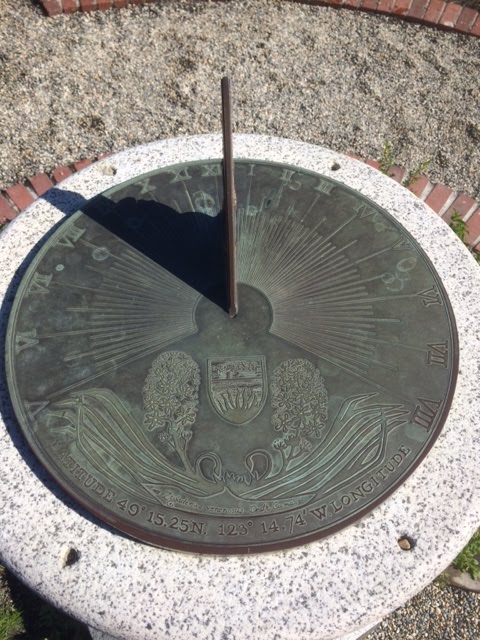
Today we visited the UBC Botanical garden. We started in the Physic garden, looking at the different herbs used for medicine. We were also discussing how we can relate the garden with our teaching. We had ideas such as scavenger hunt, soundscaping, smell-scaping, and relating it to history or literature. For math, I think the shapes of the beds are interesting. We can find the area using area of the sector. We can also look at angle on a sundial and do a project of making sundials.


We continued exploring the UBC Botanical garden and discovered this beautiful amphitheatre. Certain spots in the center of the stage amplifies and echoes the sound, we had fun trying to find the spot. This could also be a math exploration on sound waves and relating it to trigonometric functions. This beautiful water fountain structure is called the Hypanthium. We were also discussing why water runs along the surface of the structure and not fall off the edge. Before we left the Botanical garden, we explored the vegetable garden and discussed ideas for our Saturday workshop. We continued working on the workshop in the afternoon at UBC Orchard Garden.

Friday, 6 May 2016

May 6 - Orchard Garden CFE

May 6 Blog Post- Orchard Garden CFE


Laura- Stories

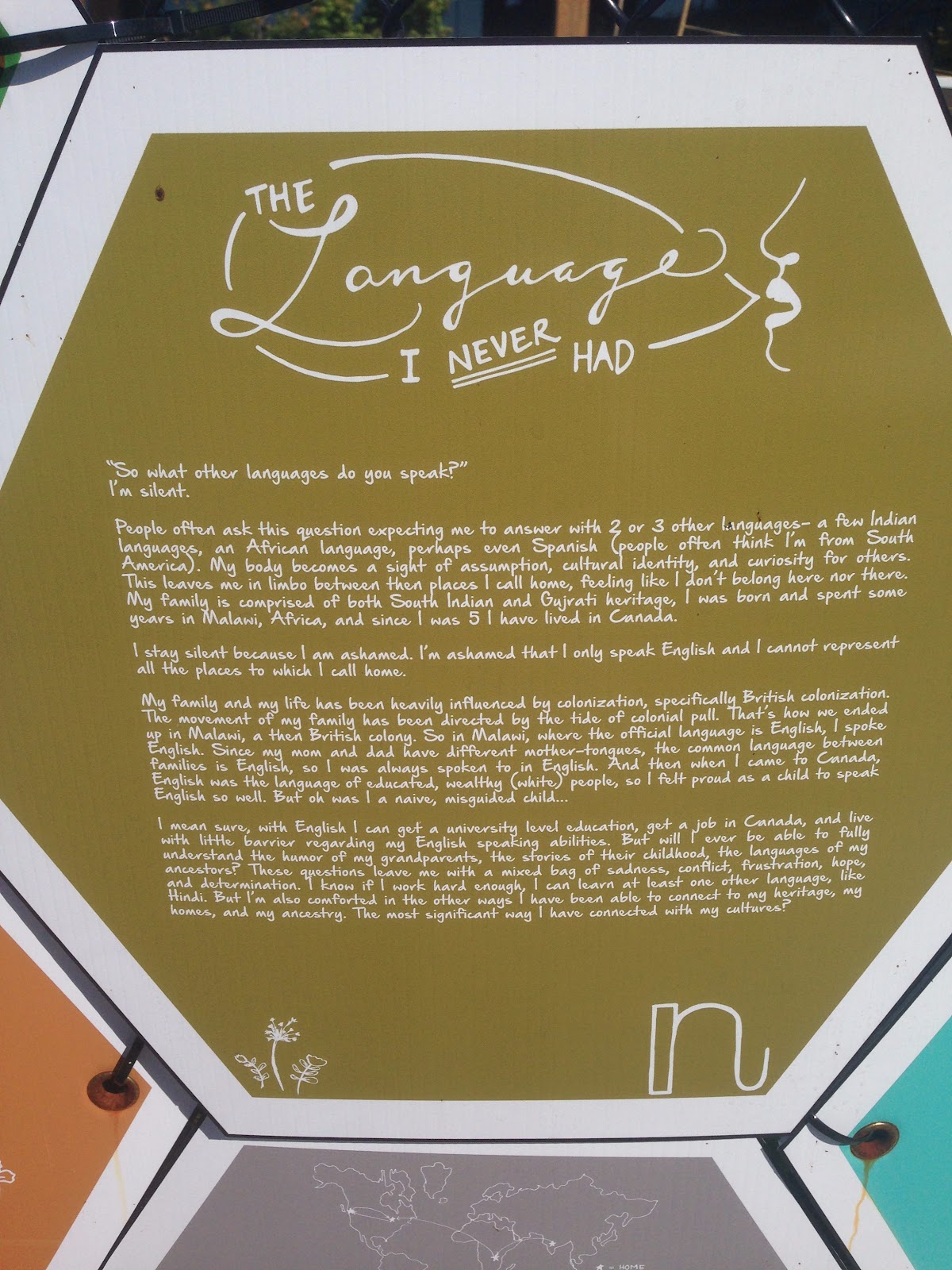
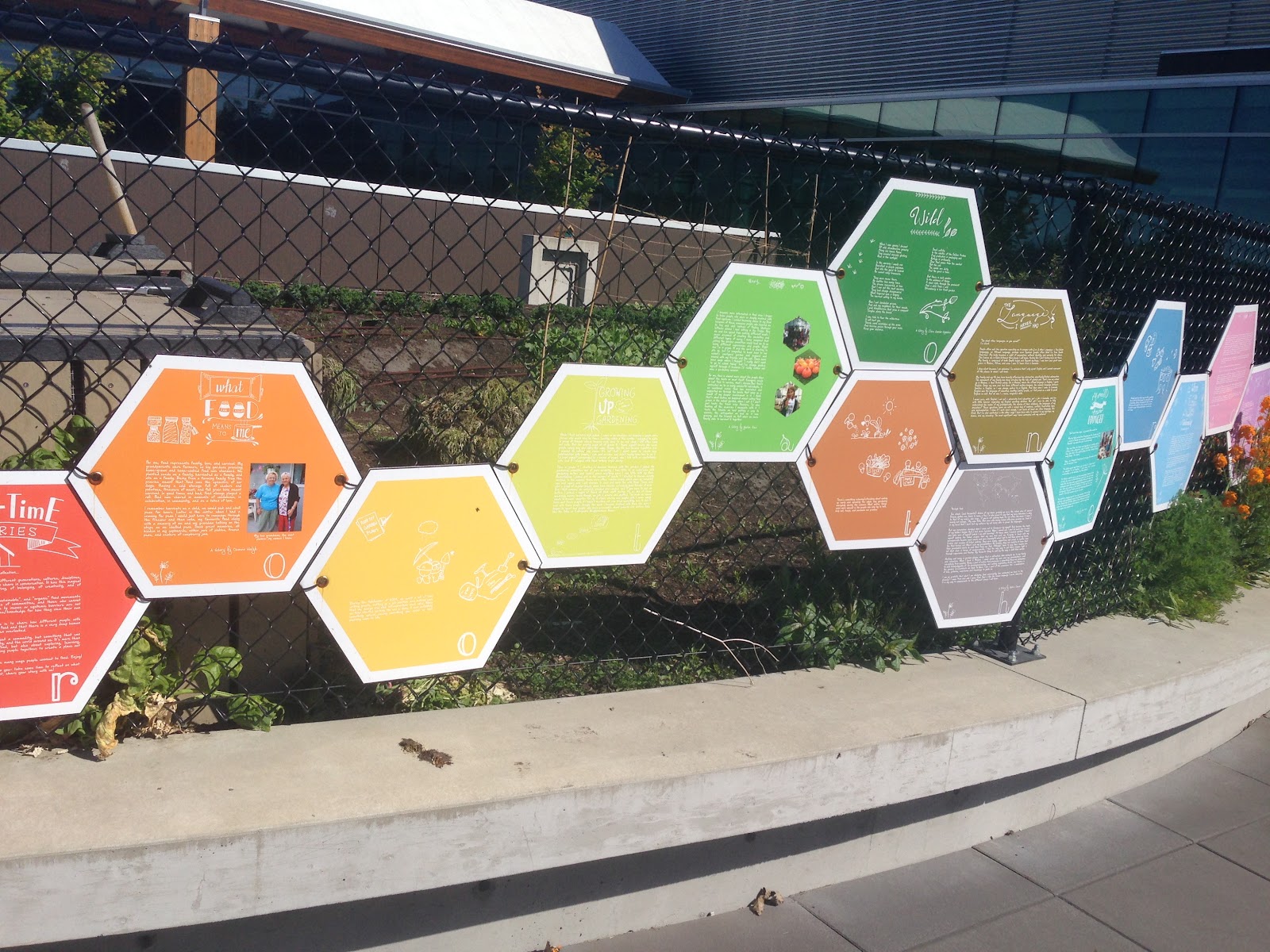
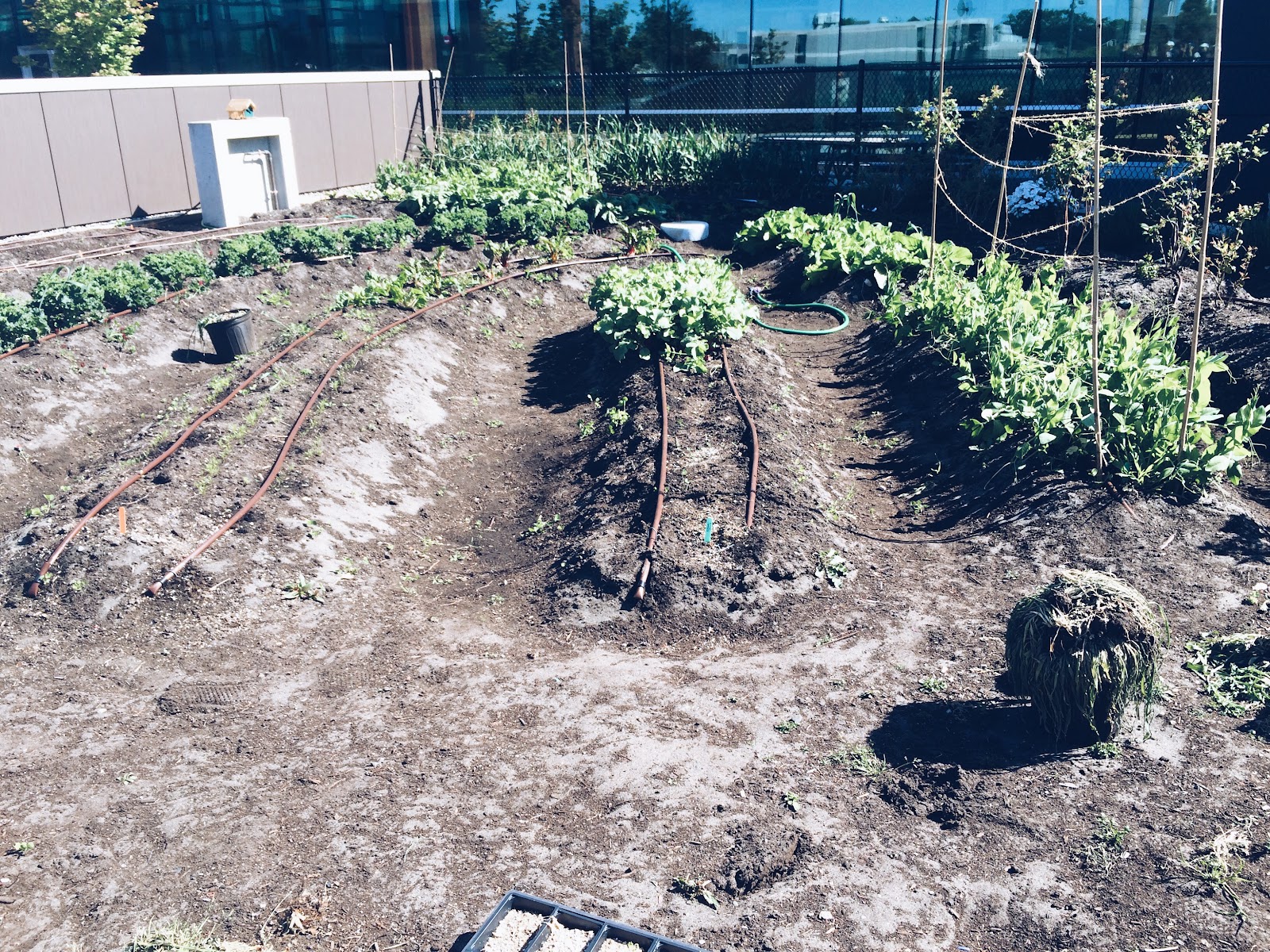
Today we had the pleasure of being introduced to the garden on the roof of the NEST called “Roots in the Roof.” Brandon delved right into the garden and what it’s trying to represent. What really caught my eye were the hexagonal stories that were intertwined with the fence that wraps around the garden. Each hexagon contained a different written piece; whether it be a poem, a story, or an experience. One hexagon that really affected me was the poem about a student whose mother passed away. She connected her experience to food, and how her mother would always get up early so she could make her breakfast. She expressed how just a small gesture could mean so much; something as simple as getting up earlier than her to take more stress off her for the day was incredibly meaningful. It really moved me and it helped me understand how something as normalized as food can hold such an important place in someone’s heart and memories. Brandon expressed how important community was to the project, and seeing these hexagons really brought that home as each person was connecting through a different experience, but it was all based on the same thing: food. It was really awesome to see such a beautiful display of English being used to connect to the garden through poetry, storytelling, and experiences. I would definitely consider using a project like this in the future if I’m able to start a garden!

Aman- Salad bowl game

Following our tour of the Roots on the Roof garden, Brendan introduced us to the salad bowl game. The purpose of this game was to refresh our memories of the different plants growing in the garden and what we had learned throughout the discussion about the garden (I.e. What connections we made, etc.). Once we were split into two different teams, one member would choose a random slip of paper that had a plant name on it and had to describe it to the teammates, who had to guess the name of the plant. The game was quite interesting because we were able to review what we learned and hear all the different connections everyone made regarding the chosen plant. Hearing these different connections helped us remember the plant for future rounds (I.e Italian was the description given for oregano, purple was the clue given to describe lavender, etc). Any teacher could modify this game to fit their teaching subject while also incorporating garden learning/development! For example, I could teach the students mini history lessons on particular plants in my future garden and those historical facts could be used as clues for describing the plants!


Fatima

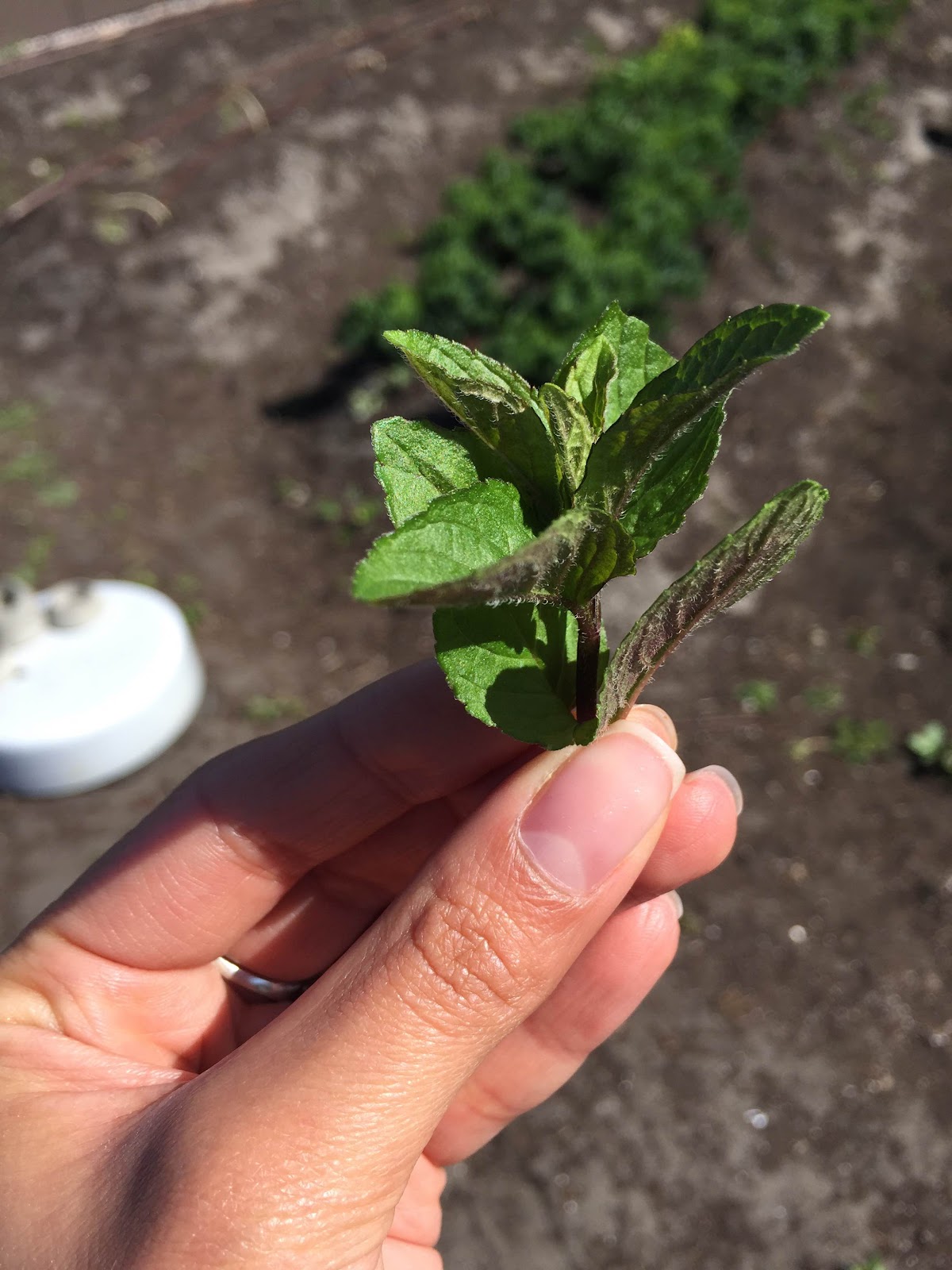
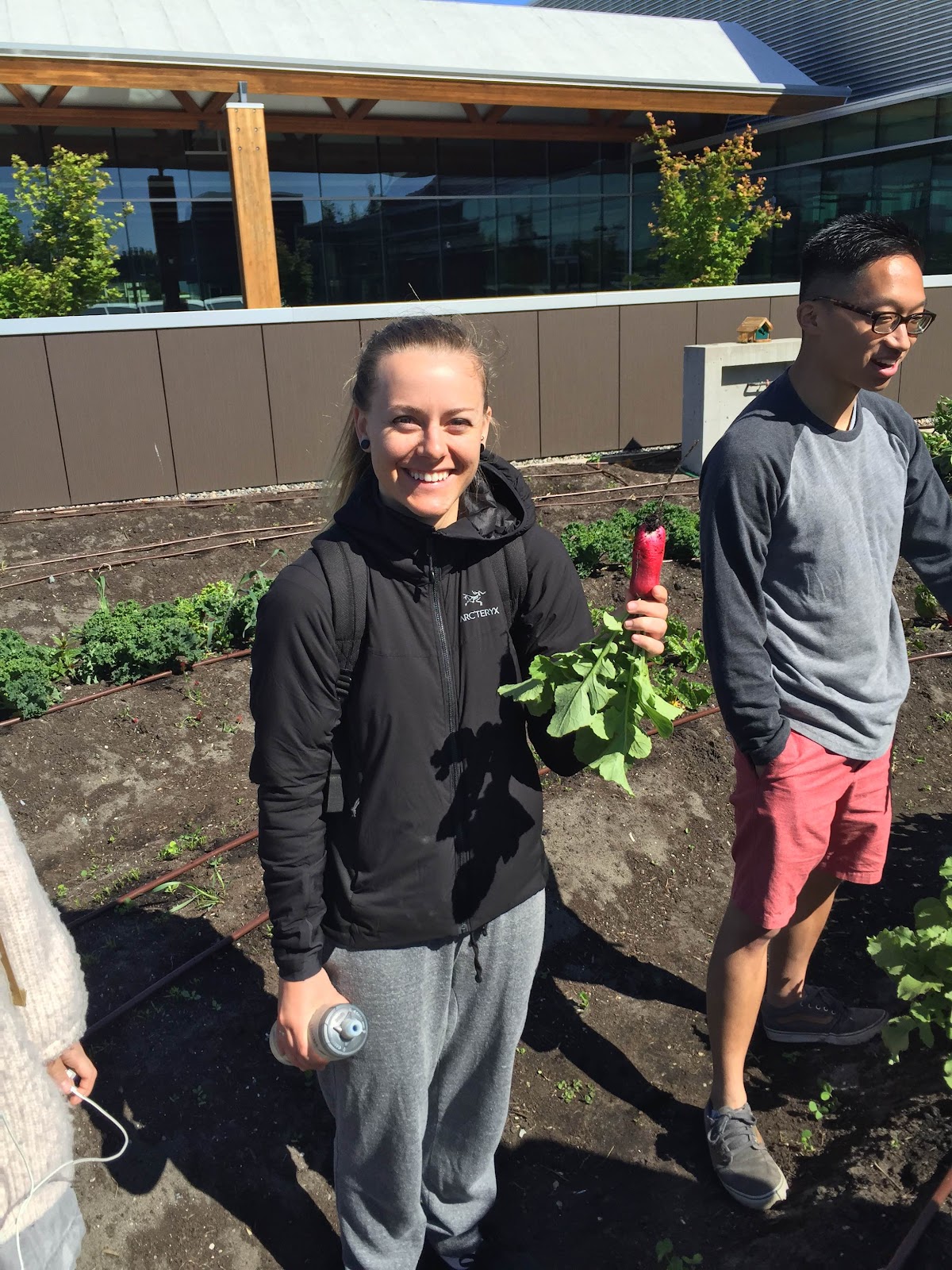
Brendan gave us a tour around Roots on the Roof and showed us all the different vegetables and herbs this little, and beautiful garden contains. Chocolate mint was what stood out the most for me; the texture, the smell, and the taste reminded me of my childhood and that was also what Brendan talked about. “ A lot of people talk about food through their experiences and memories”

We also harvested a really big Radish and Brendan washed, and cut the Radish and we all eat it. The whole experience was educational, spiritual, and fun.  

Stephanie- Progress
In the afternoon, the Orchard Garden CFE team gathered to plan our next exciting project: a garden workshop held on Saturday, May 14.  In the past two weeks we had the privilege of visiting numerous school gardens and talking with passionate educators who put a lot of time and effort into creating a garden as a community and teaching area.  With a lot of knowledge and inspiration under our belt, we began to lay out the details of our garden workshop.  Although the details of this workshop won’t be released until a later date, we are aiming to cater this workshop to be informative and inspirational, especially for educators who are interested in teaching in a school garden, and of course, fun for people of all ages! I will share that it involves teaching across the curriculum, so you by attending this workshop you will leave with knowledge not just about one subject but possibly a few.  We have a fun activity prepared for lunch as well; we hope to see some of the readers there at the Orchard Garden workshop on May 14th!

Thursday, 5 May 2016

Sofia - Orchard Garden CFE - May 5th


Today we went to lovely UBC Farm, where all kinds of great things happen! We were in the Children's Garden with the Landed Learning Project, where UBC Farm works with elementary school children to teach them all about gardening. We received a warm welcome with coffee, tea, and cookies to start off our day. There were a large number of community volunteers who come to help the children to learn about gardening; it was great to see children working with people who are all different ages. 
Every time the children visit there is a different theme to the day. Today's theme was water - which Stacey, the leader, pointed out is an essential topic especially at this time of year as we are coming into drought and forest fire season. Children learned about the importance of water for irrigation and hydration and how photosynthesis works. 
They then learned how to make "Compost Tea" which is brewed with compost, weeds and other plant parts to create a nutrient-rich "tea" which delivers nourishment and aerobic bacteria to the plants. It also acts as a pest and disease suppressant. 


The Landed Learning days seem to be a fantastic and innovative way for young students to learn not only gardening/outdoor skills, but also valuable information about science, nature, math (through counting and calculating ratios), English (through new vocabulary, garden planning, and communication) and many other things. There is also a great social-emotional component, as students need to not only work with their classmates, but also with community members of all ages. Without working and cooperating together, they would not be able to accomplish as much as they do. 


To end the day we spent time helping small groups of 4 - 5 students to do various garden tasks. For example, one group weeded bluebells, one harvested some kale, another got rid of some caterpillars that had invaded a tree. In total there were 5 or 6 work stations, and we got quite a bit done!


Wednesday, 4 May 2016


Tyee Montessori Elementary School Visit - May 4th


Today we visited Tyee Montessori Elementary School where students have participated in the Think and Eat Green at School project and have done a lot of cooking, knitting, gardening, and art works. The school has been decorated with students’ art works that has made the school a very beautiful place.


In the morning, we (Alice and I) helped three groups of students (Gr 4/5/6) to make seed bombs. We had an interactive discussion about the origin of the seed bombs and why seed bomb was invented in the first place. Students were very excited about this hands-on experience and the discussion which followed. We also provided them with the mathematical shapes that they were familiar with so that they could make their seed bombs in a shape that they liked. After making seed bombs, since students liked to take their seed bombs home, we helped them to rap their seed bombs.


We also had the opportunity to observe the Roots of Empathy lesson. An interesting lesson that helps young students to improve their compassionate feelings towards others.


In the afternoon, we helped three more groups of students (Gr 1/2/3) to make seed bombs.


Tuesday, 3 May 2016

Alice- CFE May 3 (week 2 day 2)

 We did the soundscape activity with Diana in the garden today. We starting with an activity to know each other better. We talked about our favorite animal, plant, outdoor activities and unique experiences we had. It was a great ice-breaker activity to know each other better and can be modified to fit any subject and classroom. Then, we played a quick game about listening. We stood in a circle and the person in the middle of the circle had their eyes closed and had to guess who made a sound.

For the soundscape/performance activity, we listened to the sounds we hear around us tried to draw a visual representation. We first did this at UBC Orchard Garden, then we walked to the forest and did the same in the forest. As a group, we collaborated our ideas together and made it into a sound/visual performance. It is very surprising how much technology noise from machines and constructions we have even in the forest. Noise pollution is something I have never thought about. Sound from nature such as bird tweeting significantly decreased after the construction sounds started. It is not just disturbing us, it is also affecting the animal greatly. I think it is a meaningful activity for us to think about what is really around us. 


Monday, 2 May 2016

Monday, May 2nd - Visits to Van Tech and Trillium Park


In the morning, we visited Van Tech Secondary School in East Vancouver.  The school has an extensive gardening program with 1,000 square metres of garden space and  sells the fresh produce on a market, with funds going back into the garden and the school.  The garden operation is run by Fresh Roots, and benefits from endless volunteers helping out.  We met agriculture students from several universities who are gaining valuable hands-on experience.  The garden is used in the core curriculum for a variety of classes at the school, ranging from biology to home economics. 


                                          Charlotte, the Farm Manager led our group this morning


                                          The school has a lovely herb garden


                                          The crops are varied and efficiently managed


                                          Many crops are protected under special materials
                                       
                                          We were fortunate to have sunny weather all day!


In the afternoon, we took public transit and headed for Trillium Park in the historical neighborhood of Strathcona, which is well known for its gardens.  This park’s perennial plantings were chosen for significance in traditional hand technology by First Nations People in British Columbia. 

                                          This lovely fence is made from the willow plant


                                          CFE students engaged in making rope from freshly
                                          harvested grass
   
                                          This is what we made!

Sunday, 1 May 2016


Community Field Experience-Day 2

Tuesday April 25th started with an interesting talk about school gardens in central regions of Ghana by Kwesi. Ghana is located in West Africa and its climate is tropical and tropical crops such as: cassava, corn, cocoa, and plantain dominate the cultivated lands.

High school students learn how to cultivate these main tropical crops. Moreover, crops such as lettuce, cabbage, and carrots are grown for learning purpose. Because of the tropical climate these crops need to be covered by shades to reduce the impact of direct sun rays.
Students also learn about palm plantation. It was interesting to know that all parts of palm trees are useful. Students learn how to use garden tools such as cutlass and hoe for weeding and pruning and how to prepare silage for animals. 

Schools gardens not only help students to appreciate the value of vegetables, but help them to improve their skills of collaboration so they will be able to accomplish group tasks. Moreover, students can replicate the school garden in their home and use their skills and knowledge in their everyday life. 


Another informative and interesting talk about “food safety from garden to school” was presented by Vancouver Costal Health. We’ve learned about food-born illness (FBI), and that produce can be contaminated (chemically, physically, microbially). We also learn that the risk of FBI can be reduced through site selection, good compost practices, good hand and personal hygiene, using pesticide free products, washing fruits and vegetables, cleaning and sanitizing food contact surfaces. 


We spent the afternoon in Orchard garden and did some work, which included weeding and planting seeds such as beats and carrots. Different herbs in the garden were introduced 
and there were lots of interesting conversations about how to incorporate what we have learned into our class activities.